Fair warning: this guide is stuck in 2015. Here I explain how we got our Iran visa that year; the letter of invitation, the prices and the waiting times all belong to it. Even in 2015 the Iranian rules changed every few months, so imagine by now. For today's requirements, always check with the Iranian embassy and your own government's current travel advice.
Want to visit Iran but don't know where to start? Rumours abounded about how complicated it was to get an Iranian visa, putting off travellers and tourists alike.
Head spinning from terms like embassy, LOI, VOA, travel insurance and paperwork? The Iran visa wasn't the simplest to sort out, but it wasn't a lottery either. Once we understood how it worked, we had no trouble getting the visa ourselves — without paying an agency to handle it all, beyond the letter of invitation — and saved ourselves both time and money.
This is the guide I wish I'd had in 2015: how the visa worked, what to bring to the embassy, how the Letter of Invitation was arranged, and what a wrong word at a counter could cost you back then. We sorted ours overland and then cycled across Iran for three months, so everything here comes from doing it the slow way.
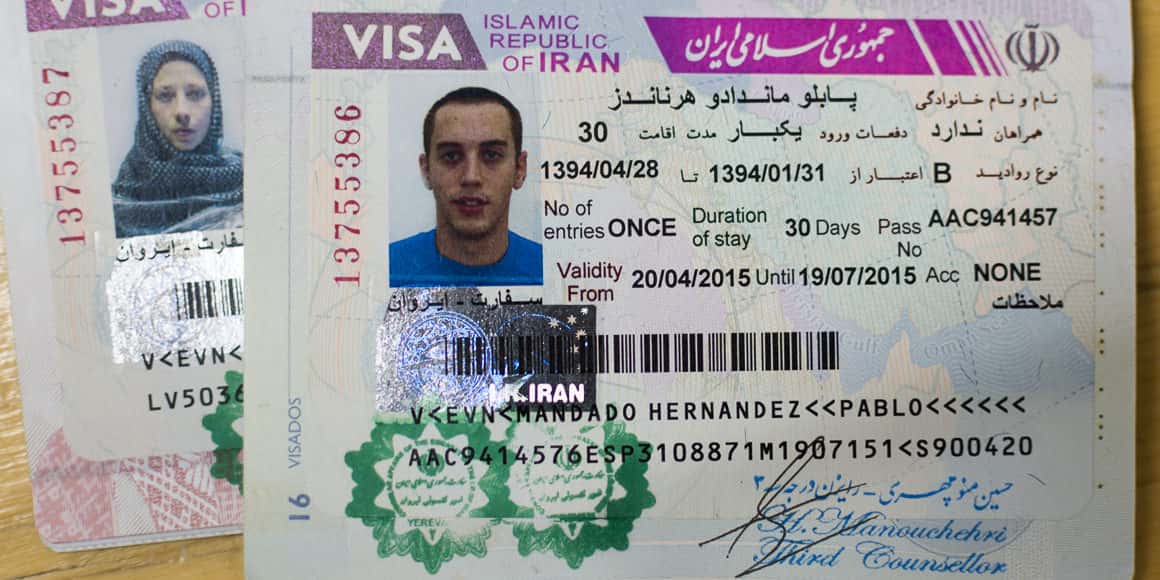
Here I collected the visas from every other country we crossed.
Iran visa conditions (2015)
Once the visa was issued, you had 90 days to enter Iran. A tourist visa was valid for 30 days inside the country from your date of entry. That meant that if you processed your visa on 1 January and entered Iran at the end of April — even though the visa would be about to expire — you'd still have your 30 days on Iranian soil.
To calculate the total cost you had to factor in both the visa fee itself (around €50, depending on the embassy and the urgency) and the letter of invitation (roughly €20–35, depending on the agency and any offers running at the time). So the real total cost of the visa came to around €80 for one month in Iran.
What did you need in 2015 to get the Iran visa?
The first thing was to find the Iranian embassy where you wanted to apply. We did ours at the Iranian embassy in Yerevan (Armenia), but almost any other consulate would have done.
Conditions could vary depending on the embassy, but in general these were the requirements:
- A valid passport with more than 6 months' validity and no trace of travel to Israel. Bear in mind that if you had stamps from border posts near Israel — such as Egypt's or Jordan's — that could be grounds for rejecting your visa. In that case, the fix was to apply for a second passport to avoid problems with the application or at the border.
- Passport-sized photos. Some countries could be stricter about the size, but I was still using the same ones I'd printed at home more than five years earlier and never had an issue. Depending on the embassy, they could ask for between 1 and 3 photos. Women had to cover their hair and neck in the photo — as on entering Iran — with a headscarf, in the Iranian hijab style.
- Around €50 in cash, paid into the bank the embassy of the day pointed you to. The amount could vary, and at some embassies you could pay extra to speed things up (between €20 and €30 for the express process, depending on the embassy).
- A letter of invitation, also called a Letter of Invitation or LOI. Don't worry — I explain it further down.
- Proof of travel insurance. Any will do. Real (or not). Some embassies will ask for travel insurance when you apply, but not all. It's a formality they don't really check — so Photoshop isn't entirely out of the question. If you have paperwork for insurance linked to a bank card, those documents work fine, especially if you're applying outside Spain and the paperwork is in Spanish. If you genuinely want proper cover, personally I'd recommend AVI travel insurance. I weighed up the whole question in should I get travel insurance?.
- Fill in a form. The embassy gave you one to complete with your personal details and an itinerary that didn't need to be real — a list of tourist cities and a random hotel in each one was enough. Tourist visas ran up to 30 days, and it was worth putting in dates that covered a full 30-day period to make sure you got all 30; some embassies — in some cases — had issued visas of under 30 days when the dates didn't justify them.
Under normal circumstances that was everything the embassy asked for, though in some cases they could also ask for proof of a flight. We said we were going overland, by bus. Whatever you do, don't mention you're going by bicycle (or on foot) — that's likely to get your visa refused.
Don't worry though — once the visa was in your passport, you could cross the border on a tricycle, or hopping on one leg if you fancied.
Letter of Invitation for Iran (LOI)
This is a document certifying that Iran's Ministry of Foreign Affairs has approved your entry into the country. The only way to get one was through an agency — at the time it wasn't possible to arrange it through a private individual.
In 2015 it was essential when applying for the visa at an Iranian embassy. A few months earlier there had been embassies where you could get an Iran visa without a letter of invitation, but from the spring of 2015 embassies like the one in Trabzon, Turkey, stopped doing so and required an LOI from everyone applying for an Iran visa.
There were many agencies offering this service, and plenty of scammers too. The only agencies I recommended were Key2Persia or Touran Zamin. The cost varied but hovered around €30, and they sometimes ran temporary promotions at reduced prices (we used Key2Persia for €22.50).
They all worked in a similar way: you contacted them by email or through the form on their website, and they replied with payment details — typically a bank transfer to an account in Germany or another EU country.
If you made that transfer from a bank with free EU transfers, you saved yourself extra charges. Once the payment arrived they started processing the LOI, and within up to 10 days — 5 in our case — you received an email with the letter and a reference code, which was all the embassy asked for; they got a fax from Iran's Ministry of Foreign Affairs with the letter. Inshallah.
Once the email arrived you could head to the embassy — where in some cases it took them a day or two to receive, or find, your letter of invitation — and the visa application got under way.
Things to keep in mind (2015)
Never, NEVER say you're travelling to Iran in your own vehicle, by bicycle, on foot, or by any other alternative means of transport. Your visa won't state the mode of transport, so you can say whatever you like (plane or bus), but don't mention any other form of transport when applying for either the LOI or the visa at the embassy.
If you were going "by bus" you didn't need to fill in the fields about airports and flight numbers.
Remember that women had to have their hair and neck covered in the photos. It didn't need to be an Iranian headscarf — any headscarf, a scarf, a buff or even a bandana would do. But every photo submitted had to show hair and neck covered.
When it came to filling in the form with your itinerary, the usual picks were tourist spots like Tabriz, Isfahan, Shiraz or Tehran. You filled it in first when applying for the LOI, and it was fine to copy it and use the same one — to save yourself work, more than anything — for the embassy application and in case they asked at the border.
Mentioning professions related to journalism, such as working as a photographer, was asking for trouble. Housewife or student, on the other hand, raised no problems. Inshallah.
Visa on arrival at the airport (2015)
How were you getting to Iran? By land, sea or air? If you were flying in and staying no more than 15 days, it was possible to get the visa directly at the airport.
Also known as visa on arrival (VOA), this was the simplest and potentially the cheapest option — though also the riskiest, since you had no absolute certainty your visa would be approved until you were standing in the airport in Iran. You wouldn't have been the first to be sent back on the next flight out.
The cost of the visa on arrival in Iran depended on your nationality, but was generally the same as a 30-day tourist visa from an embassy: €50.
Officially it was advisable to have a letter of invitation for the visa on arrival, which reduced the risk of being turned away — though that risk was minimal and couldn't be eliminated entirely anyway. Personally, if I'd taken my chances with a visa on arrival, I wouldn't have spent the money on the LOI.
Not all nationalities could get a visa on arrival at the airport. In 2015, nationals of the following countries were the ones who could obtain this 15-day visa: Spain, Albania, Armenia, Australia, Austria, Azerbaijan, Bahrain, Belarus, Belgium, Bosnia and Herzegovina, Brazil, Brunei, Bulgaria, China, Colombia, Croatia, Cuba, Cyprus, Denmark, Egypt, Finland, France, Georgia, Germany, Greece, Hungary, India, Indonesia, Ireland, Italy, Japan, Kazakhstan, North Korea, South Korea, Kuwait, Kyrgyzstan, Lebanon, Luxembourg, Malaysia, Mexico, Mongolia, Netherlands, New Zealand, Norway, Oman, Palestine, Peru, Philippines, Poland, Portugal, Qatar, Romania, Russia, Saudi Arabia, Singapore, Slovakia, Slovenia, Sweden, Switzerland, Syria, Tajikistan, Thailand, Turkmenistan, Ukraine, United Arab Emirates, Uzbekistan, Venezuela, Vietnam.
Extending your visa in Iran (2015)
Once in Iran it was possible to renew the visa — a relatively straightforward and cheap process. For under €10 you got another 30 days in the country if you'd entered on a tourist visa, or another 15 days if you'd got your visa on arrival at the airport.
We renewed our visa twice, both times in Tehran, near the Tehran Pars metro stop. The process took place at the police station for "Foreign Aliens" and cost around 350,000 rials (under €10 at the exchange rate of the day).
Requirements to renew the Iranian visa:
- A photocopy of your passport and your visa.
- Filling in a form (any address would do — a random hotel if you were staying with friends).
- A photo.
- Paying around 350,000 rials at the bank they sent you to.
Then waiting — a few hours, a day or several days, depending on where you applied and on whether it was your first extension (possible to get the same day) or your second (which could take up to a week, since it had to be sent to Tehran).
They would sometimes tell you the process was going to take several days for the first renewal, or a week for the second — but if you insisted, in the end they got it done in less time. Inshallah.
Exceptions (2015)
If you weren't going to travel across Iran and were only visiting Kish Island, you didn't need a visa unless you wanted to stay more than 14 days.
Some countries had special agreements with Iran and didn't require a visa to enter. As well as several neighbouring countries, nationals of Venezuela, Nicaragua, Bolivia and Ecuador were exempt.
If your passport was American or British, things were complicated — at least at the time. It was possible to travel in Iran, but only on organised tours, not independently. There were rumours this would change over the following months, but nothing firm back then.
Risks and fears
With the visa excuse out of the way — the 2015 one, at least — what's your next reason not to go to Iran?
Danger? Terrorists? Don't let anyone fill your head with that! Iran is one of the safest countries I've had the fortune to travel in, and one of the most hospitable — and I've been to more than fifty by now.
We spent two and a half months in Iran and the biggest risk was being constantly invited into people's homes — by strangers we met on the road, and then their friends and family afterwards. If you want a feel for the place beyond the paperwork, I put it all into pictures in cycling through Iran — a journey in photos, and the run-up to the border itself was an adventure of its own: the incredible border road between Iran and the Caucasus.
Persian hospitality is extraordinary, and I'd encourage everyone to visit before mass tourism takes hold and the country loses its authenticity.
Frequently asked questions (2015 answers)
Do I need a Letter of Invitation (LOI) for the Iran visa?
In 2015 you did, at least for an embassy application: from that spring the LOI was essentially unavoidable, and only agencies could arrange one — never a private individual. The exception was the airport visa on arrival, where it was recommended rather than required. Whether any of that machinery still exists today, I can't tell you; the Iranian embassy can.
Can I get an Iranian visa on arrival at the airport?
In 2015 you could, if you were flying in, staying no more than 15 days and holding one of the eligible passports. It was the simplest and often the cheapest route, and also the riskiest: nothing was guaranteed until you were standing in the airport in Iran. Arriving overland, it wasn't an option at all. What the airports offer today, I don't know.
How long is the Iran tourist visa valid for?
The 2015 tourist visa gave you 30 days inside the country, counted from the day you entered, with a 90-day window from issue in which to make that entry. The airport visa on arrival was shorter, typically 15 days, and both could usually be extended in-country. Today's durations are the embassy's to tell you, not mine.
Can I extend my Iran visa once I'm there?
In 2015 you could, and it was cheap and fairly painless — we extended ours twice in Tehran. A tourist-visa extension added another 30 days; the visa-on-arrival kind, around 15. First extensions were often same-day; second ones could take up to a week. That's how it worked then, not a promise about now.
Can US, UK or Canadian citizens visit Iran independently?
Not in 2015: American, British and Canadian passport holders could generally only travel as part of an organised, guided tour. Even then there were rumours of change, which tells you how fast these rules moved — check the current situation before counting on anything.
Should I tell them I'm travelling by bicycle or on foot?
Absolutely not. Whether you're applying for the LOI, at the embassy, or being asked at the border, only ever say you're arriving by plane or bus. Mentioning a bicycle, motorbike, your own vehicle or walking is a classic way to get a visa refused. Once it's stamped in your passport, how you actually cross is your business.
Enjoy Iran! Inshallah!
What you ask me most
- Does this guide still work for getting the Iran visa?
No. It's the record of how we got ours in 2015: the letter of invitation through an agency, the visa at the embassy in Yerevan and the extensions in Tehran. Even then the rules changed every few months. For the current requirements, check the Iranian embassy's website and your own government's current travel advice.
- Where did you arrange your Iran visa along the way?
In Yerevan (Armenia), in 2015; we paid the fee at the Mellat Bank, next to Republic Square. That was how it worked that year — whether any of it still holds is a question for the Iranian embassy, not for this post.