Iran is a country of contradictions — anchored in the past and in religion by a government that appointed itself. The Iranian people are not their government, and could hardly be more different from it.
Persian hospitality is extraordinary, the food is spectacular, and the place is endlessly fascinating — partly because of how curious it all is, partly because of the sharp contrasts everywhere you look.
During our round-the-world bicycle trip, we spent 3 months cycling through Iran in 2015 — leaving the country a couple of days after the announcement of the sanctions deal — and these are some of the things that caught our attention.
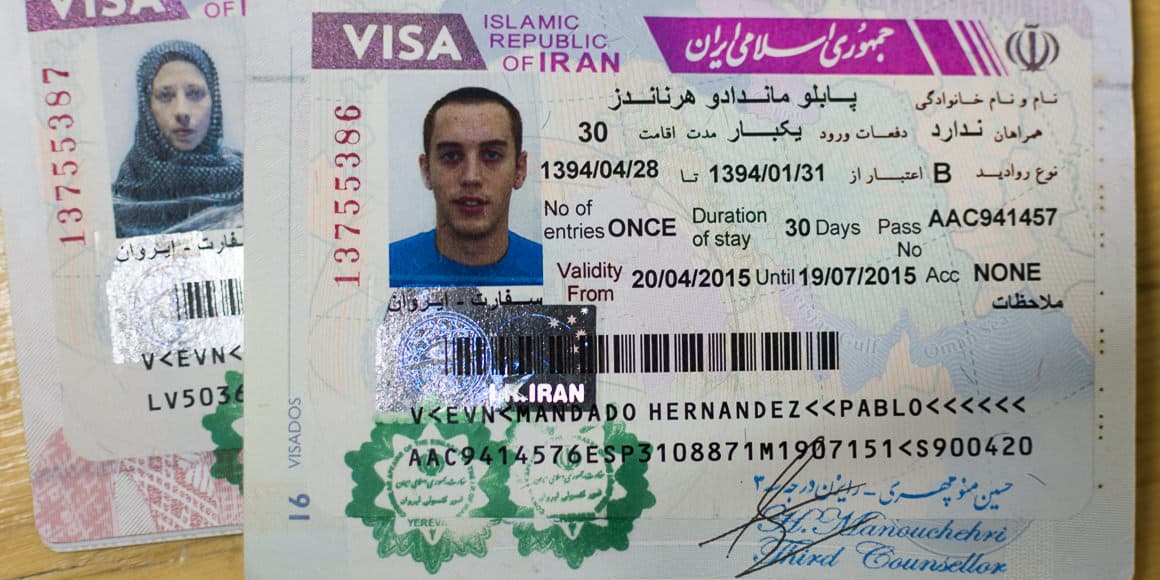
1. Visa and entry to Iran by bicycle
If you mention on your Iranian visa application that you're travelling by bicycle, your application will be rejected.
In fact, they'll reject your invitation letter outright — and you need that letter to apply for the visa. The curious thing is that once you actually show up at an Iranian border crossing with your bicycle, no one bats an eyelid.
And once inside Iran, even visiting an office to extend your tourist visa, the fact that you're cycling actually helps — they'll fast-track the process and not make you wait a week.
Here's our experience and all the visa information for Iran.
2. Music in Iran
The only music officially accepted in Iran is Iranian folk music and folk-pop — but a walk through any Iranian city will surprise you with every kind of music blasting from cars, houses and shops.
Enrique Iglesias is a hit in Iran.
3. Tarof
Never heard of it? If you go to Iran, tarof might be the first thing you encounter — or at least everything anyone does will be shaped by it.
What is tarof? Tarof is a way of relating to others and acting in the world, rooted in Persian tradition and hospitality. It's a convention in which services and goods are offered to others — especially to guests and strangers — free of charge.
I go into a shop in Iran to buy cheese, eggs and tomatoes. I go up to the counter and ask how much.
— Nothing, nothing.
— What do you mean, nothing? How much does it cost?
— It's free, I don't want your money.
— Are you sure?
— Well, alright, it's 6,000 toman.
It works in reverse too. When someone offers you something, tarof requires that you refuse it. And so on, repeatedly. After several offers you'll accept and say thank you.
— Are you hungry? Do you want some cherries?
— No, thank you.
— Sure?
— Yes, I'm fine, I don't want anything.
— Okay...
— Actually, go on then, yes I do. Thanks.
This applies to our own responses too. Sometimes we're resting in the shade of a tree, planning to get back on the bike in a few minutes.
Someone arrives and offers to take us to their home to rest.
— No thanks, we're going to keep cycling soon.
— Come on, come to my house.
— No, no, thank you.
He grabs my hand and insists.
— No, honestly, no.
— You want to, come on.
— I don't want to.
— It's not tarof — I'm being serious, come to my house.
— I don't want to, honestly, it's not tarof either, I want to keep cycling...
The problem is when tarof applies to everything — at that point reality and fiction become impossible to tell apart and you have no idea when someone is genuinely offering something and when they're just being polite.
People have even offered to build us a house to live next to them, and when someone invites us to their home they ask how many months we'll be staying. How serious are they?
3. The Iranian economy
Due to sanctions, Iran has a restricted market and its main business is selling oil and gas to China.
It maintains good relations with Russia, to which it exports food. On a smaller scale, it exports olive oil to China and Japan; gas to Turkey and Armenia; and saffron and caviar to various markets.
The most curious export goes to China: Iranians eat the chicken and send the feet to the Chinese.
4. Oil in Iran
Iran has one of the world's largest reserves of oil and natural gas. The curious part is that despite sitting on all that oil, it has to import petrol — it lacks the technology to refine it.
5. Iranian technology
This technological gap affects everything. The quality of manufactured goods is very poor across the board: cars that fall apart, clothes that disintegrate after a few washes, electronics like MP3 players that last a very short time.
6. Nuclear bombs?
We were staying with a friend in Iran during our first weeks there, about to eat something.
There was bread and a tub of soft cheese on the table. When I tried to open it by the easy-open tab, it broke. An inherent flaw in every easy-open tab in Iran — I never found a single one that worked.
Our host picked up a knife, laughing, to cut the lid open, and said: Do you really think we're capable of building nuclear bombs in Iran? We can't even open a tub of cheese.
7. I do
You're at a wedding and the moment of the vows arrives. They ask the bride: Do you take this man to be your husband? Silence.
Then the women in the front row say in unison: "The bride has gone to pick flowers!"
They ask again: "Do you take this man to be your husband?" Again in unison: "She's not here! She's gone to the market!" And the third time: "Do you take this man to be your husband?" Yes, I do.
Again, tarof taken to its logical extreme. A woman can't say yes immediately — that would be "too easy".
8. Wedding celebrations
The Islamic government doesn't consider it appropriate for men and women in party clothes to share a space, so many weddings are celebrated separately — men on one side, women on the other.
In Rasht we attended a wedding. If you hold the wedding in a venue in the city centre, men and women will be separated. In the outskirts, a restaurant may allow them to be together — after bribing the local police.
Unfortunately, the police chief of the region had decided to tighten controls, and our hosts got an unpleasant surprise. Having already paid for the venue, they were told the celebration would have to be segregated — and if they didn't like it, they wouldn't get a refund.
So, reluctantly, everyone had the wedding on opposite sides of a wall.
Whether weddings are held separately or not depends on the region and the local police chief. In some places it's easier to get around than in others, and sometimes it's possible to hold the event in a garden in the countryside — though even then the police tend to appear and a bribe is usually required.
9. Religions recognised by the Iranian constitution
Only four religions are recognised in Iran: Islam, Christianity, Judaism and Zoroastrianism.
Everyone in Iran must observe the Muslim traditions imposed by the government as law, but the other official religions are tolerated and granted some exceptions for their religious practices.
Any other religion — or no religion at all — is illegal and persecuted.
10. Religious discrimination in Iran
If your religion isn't one of the four above, you have a problem. We spent several weeks with a Bahá'í family and the persecution they endure is real. They can't access university education or public sector employment.
In some sporting competitions they're not allowed to participate, and in others — even if they win — they're denied their prize.
The treatment is inhumane, and the government effectively pushes them into exile. Around half of all Bahá'ís end up leaving Iran to live in the Americas — or so they told us — while the other half survive in Iran as second-class citizens.
11. Bahá'í villages
Villages made up of members of unrecognised religions, like the Bahá'í faith, are abandoned by the government in a clear attempt to isolate them and force them to leave.
We spent an afternoon in a small Bahá'í village in the mountains where the only thing the government had renovated in recent years was the mosque at the village entrance — left abandoned, since nobody there is Muslim.
Pipes are old, electricity lines are failing, they suffer regular water and power cuts, they have no internet, the roads are barely roads — but they did get a mosque. Just to rub it in.
12. Copyright in Iran
Iran doesn't recognise copyright, which means any counterfeit or copy is legal. Pirated goods are sold openly in legitimate shops.
13. Brands
This leads to a proliferation of fake McDonald's on the streets, Zara shops — complete with Zara paper bags in the window to make them look convincing — and restaurants using the FC Barcelona logo and typeface.
Obviously these are just rip-offs, and Iranians themselves find the more extreme cases funny. With the Zaras, though, I'm not entirely sure the customers always know they're not actually buying from Zara.
14. Iranian cars
The only cars you can buy at a reasonable price are those manufactured in Iran. French brands licence their 20- or 30-year-old production lines to be built locally.
Imported cars cost two or three times more thanks to enormous import duties. There are areas called "Free Zones" where imported cars can be bought duty-free, but with special number plates that restrict them to use only in that region — they can only be taken elsewhere for a few days a year.
15. Bank interest rates in Iran
Interest rates at Iranian banks are very high, as is inflation — though the latter has moderated in recent years. It's possible to get 20% interest on bank deposits.
16. Paying rent via deposit
Because deposit rates and lending rates are so high, and property investment is so intense, a parallel market emerges.
You can rent a home in Iran without it costing you a single cent — you just need savings and to sacrifice the interest.
Want to rent a new flat in a good neighbourhood? Instead of paying monthly, make a deposit to the landlord covering the entire year — a total amount three or four times what you'd pay in rent — and when the lease ends, he returns your money.
He avoids taking out a loan. You give up the opportunity to invest that money — and it will depreciate in the meantime.
17. Hijab in Iran
The hijab is the Iranian headscarf, compulsory for all women in Iran — it covers the hair and neck. Depending on the region, different degrees of coverage are tolerated: worn further back and showing part of the neck, or covering the entire head except the face. Ilze loves wearing it, especially while cycling. Irony off.
18. Pointless prohibitions
Want a swim in the river? Sorry, that's prohibited. Want to go to the sea? Sorry, also prohibited.
— Why can't I swim in the river? I ask an Iranian.
— Oh, I don't know, it's dangerous.
— Dangerous? Put up a "danger" or "caution" sign, but why ban it entirely?
— Oh, I don't know, the water moves very fast. A sigh.
— Why can't I swim at this beach?
— It's deep!
— And? I want to swim, not walk on water!
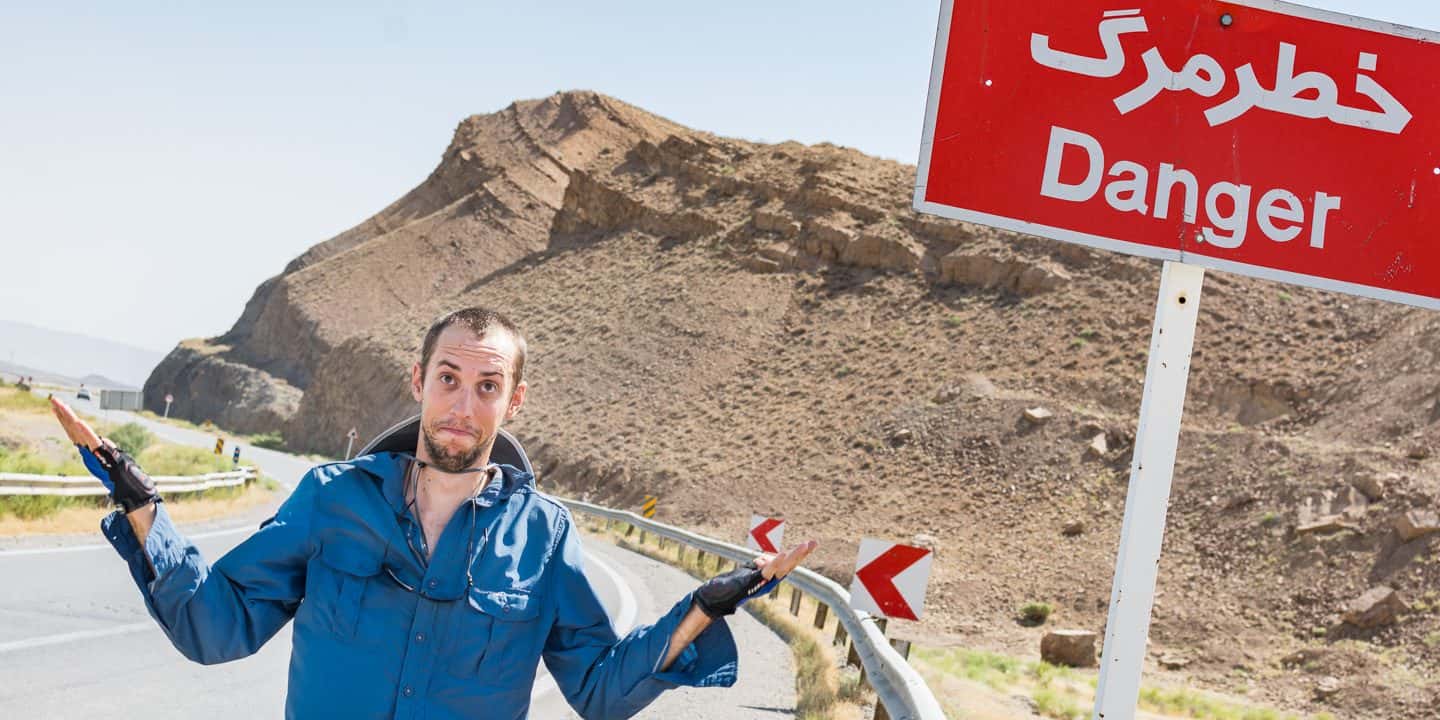
19. Danger in Iran
This constant prohibition creates genuine government-induced learned helplessness in the Iranian population. Because even the most ordinary things are banned, everything becomes dangerous.
When I finally find a beach with no "prohibited" sign, I happily wade in with an Iranian friend and start swimming.
— Where are you going!
— What do you mean, where am I going? Swimming.
— You can't go that far, it's dangerous, it's deep.
The look on my face said it all. Dangerous? Deep? The water is below my waist.
Another day I camp on a beach, setting up as far as possible from the car park and the bar — I want to sleep without questions or noise. We'd barely been there half an hour before people came with torches asking questions. Instead of stepping out, making small talk as I usually do, declining their offer to come to their house, and getting back to my sleeping bag — this time I shouted at them repeatedly to leave me alone.
When I was finally about to fall asleep: lights again. What is it now? Leave me alone, I want to sleep.
Voices next to the tent, the headlights of a car pointing straight at it. Furious, I climbed out of my sleeping bag in my underwear and went outside hoping the sight of me would be enough.
This time it wasn't just the same people — they had two police officers with them who asked for my passport.
— I just want to sleep. Leave me alone.
— Passport.
— For the love of...
I went back inside, put trousers on and came out with the passport.
— You can't sleep here, it's dangerous.
— Dangerous? No. It's safe. I want to sleep.
— No, it's dangerous, you have to go over there, where the lights are.
— Where the lights are? I want to sleep, not party. I don't want lights.
— Yes, it's dangerous here in the dark.
— No, it's not dangerous. Leave me alone. I want to sleep.
After half an hour of this, they finally let me get back to sleep and the cars left.
Thirty minutes later more cars arrived — a different police car, different uniforms.
— Passport.
— Again?
— Passport.
— Let me sleep.
— Passport.
— Go to hell.
— Passport.
— For crying out loud.
I stepped out of the tent again, clothes thrown on, passport clenched in my teeth.
Three officers this time, one of them plain-clothes. He took the passport and started filling in some form, while all three insisted I had to leave — it was dangerous.
— No, it's not dangerous.
— Yes, you have to go into the light.
— No. Moving the tent means emptying it and dismantling it — at minimum an hour with all the faff, and then I won't be able to sleep with the noise and the lights anyway.
Their English was limited to two or three words. They spoke in Farsi, I answered in English. The only English words they had were "passport", "danger" and "go".
This loop went on for another half hour until they finally got bored and told me I could sleep.
I got back into the tent with my passport and a handful of mosquito bites — only for them to call me out again fifteen minutes later.
This time I answered in Spanish, telling them exactly where to go with a range of colourful vocabulary, but eventually I came out again. Now there were the two original officers plus two of the later ones.
— What now?
— Passport.
— Oh, for pity's sake.
— Passport.
— What do you need it for? Take a photo of it and let me sleep.
— Passport.
— ...
— You can't sleep here, it's dangerous.
— Dangerous?
— Yes, cars pass nearby.
— The only cars are yours, and they're ten metres away.
— But they won't see you — there's no light.
— You saw me perfectly well. I only wish you hadn't.
— But they won't see you.
— That's the idea.
— It's dangerous.
— No.
— Yes.
— No.
— Yes.
— No.
— Here, your passport — you can sleep.
— Hallelujah. Goodbye. Don't disturb me again. Inshallah.
They left. I got into my sleeping bag. Is this the last time? I closed my eyes and fell asleep.
About forty minutes later, the headlights of two cars lit up the tent again.
— Hello! Passport.
— ...
I came out of the tent. Two of the previous officers and a new one who spoke five words of English instead of three repeated the same script.
— No, it's not dangerous. Leave me alone.
— Yes, it's dangerous, the light...
— I don't want light. Leave me alone.
— The road...
— The road is ten metres away. Leave me alone.
— Someone will come and rob you or attack you with a knife!
— The maniac with the knife is going to be me if you don't let me sleep.
— There are dogs! Very dangerous.
— Dogs?
At that point I started laughing.
— Just let me sleep. I want to sleep.
— Alright, okay, goodnight.
— Goodbye.
20. Driving
Iranians are reckless drivers. They drive without thought and without any concern for consequences. Most cars are not in good condition.
During the weeks we were processing visas for Central Asia we left the bikes and hitchhiked.
We had drivers in new imported cars who told us not to worry — shortly after nearly giving us all a heart attack — since the car had 6 airbags. No problem if we crash.
Another driver asked if I'd ever been in a car accident, and if not, whether we could have one now so I could "pop my cherry". No, no, thank you.
Cycling along we'd watch cars pass within centimetres of our bikes, with the narrowest of margins.
But the worst isn't the side clearance — it's the sudden stops. In Iran most vehicles function as informal taxis, stopping for any pedestrian to offer a ride.
Cycling, we'd constantly watch cars overtake us and then brake hard to a stop immediately in front of us. After several scary experiences we started cycling in the left side of the right lane rather than the right side. That way we had an escape route when one of these lunatics cut across us.
21. Petrol prices in Iran
Humans always complain about everything, so Iranians complain about petrol prices. But compared to European prices they're nothing. A litre of petrol cost around €0.20 in 2015 — six or seven times cheaper than in Spain.
22. The car for everything
The real reason they complain about petrol costs is that they waste it enthusiastically. Iranians use the car for absolutely everything. If the family has one car and the husband has taken it to work, the wife will call a taxi or borrow a friend's car. Walking to the market — even if it's less than 200 metres away — doesn't enter the equation.
We're going on a trip! We're frequently invited out for a picnic in the mountains and go on high alert. We ask if there'll be any hiking, any walking in nature, and they say yes, of course.
We end up driving two or three hours to stop on the roadside somewhere with no view, surrounded by other parked cars. We sit down, eat, walk to the toilets, pack up and drive back for another two or three hours.
This happens every single time someone invites us to the mountains. Strange customs.
23. English, Spanish-style
The average Iranian doesn't speak English. But they're not the slightest bit shy about trying to communicate with their "Hello!", "Welcome to Iran", "Thank you!" and "Where are you from?"
They rarely go beyond these four basics, because English at school is taught to pass written exams — just as I was taught in Spain. No conversational practice, no focus on listening comprehension or pronunciation.
Just as in Spain, films and TV series are all dubbed into Farsi — so Iranians don't get used to listening to other languages either.
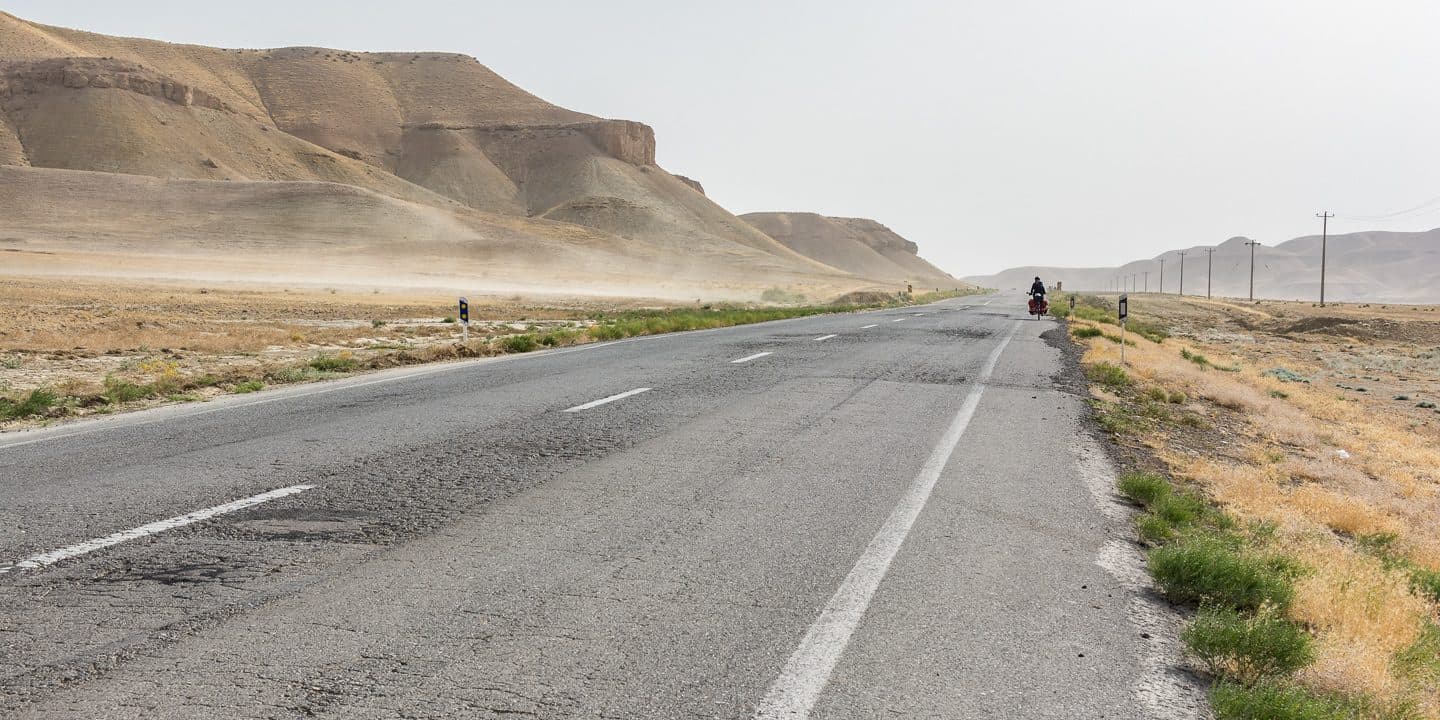
24. Much of Iran is desert
It got so hot that we fled the south of Iran and spent more time in the north, where the climate is milder — though also more humid.
Hitchhiking to Isfahan we could see the greenery disappear from the roadside, replaced by a glowing expanse of brown, shimmering in the all-encompassing sun.
The heat was stifling. We'd wanted to keep going south, but bureaucratic reasons forced us back to Tehran, and the idea of having to cross all that scorching terrain again — to push even further south into even more heat — was already giving us pause.
25. Northern Iran
Along the shores of the Caspian Sea — the world's largest lake — the climate and vegetation change completely.
The north of Iran is separated from the interior by a mountain range that gives life to this coastal zone. A dense jungle cloaks the mountain slopes all the way down to the Caspian, with extraordinary vegetation and intense humidity. It reminded us of Malaysia.
Descending from the mountains to the coastal plains, rice paddies cover much of the land.
26. Bus pilots
It's curious to see what bus drivers wear — navy dress trousers and white shirts with shoulder epaulettes in a perfect imitation of airline pilots.
27. Green fruit
Iran has an enormous variety of fruits and vegetables, but the curious thing is that many are harvested while still unripe. They eat green almonds, green peaches and green plums. And they love it.
Our stomachs never fully adjusted to eating unripe fruit, and we had the occasional digestive issues to show for it. But the taste and texture are interesting.
28. Extraordinary Persian hospitality
If one thing overwhelmed us about Iranian people, it was their hospitality. The warmth in Turkey and Armenia had already surprised us — but Iran is a level above anywhere else I've ever been. It's extraordinary.
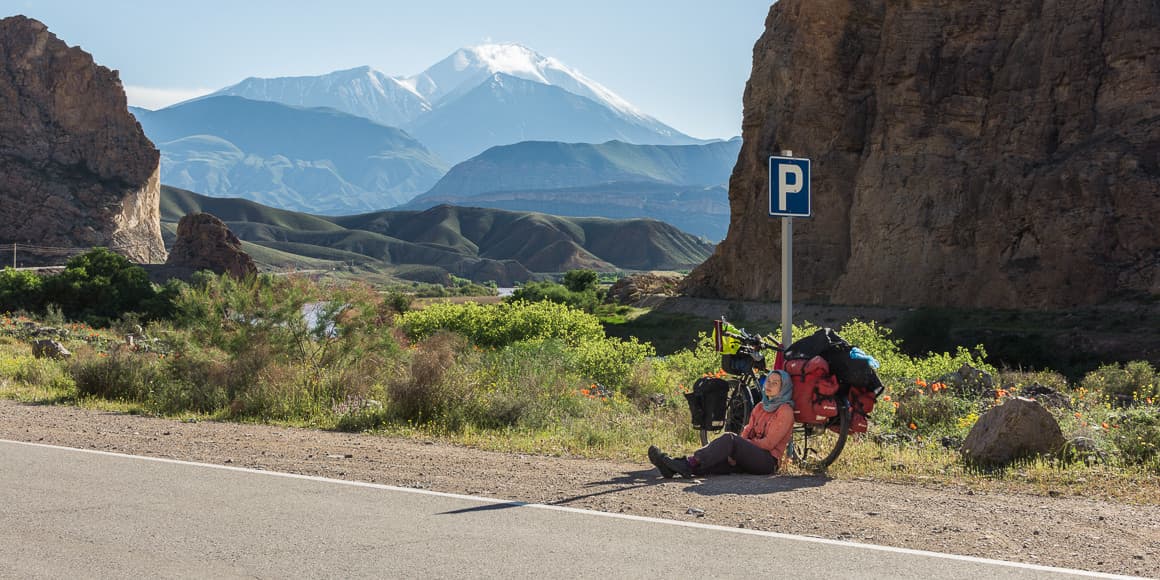
On long trips, travelling independently, what you're looking for is contact with people. And nothing compares to spending a night with a local family — conversation, watching how they live at home, eating home-cooked food.
In Iran, offers to spend the night with a family weren't occasional — they were daily. To the point where, on a single day, we'd be offered so many times that we didn't know how to keep cycling without seeming ungrateful.
Not only that: in most countries, if someone invites you to their home, they're doing you a favour. In Iran it felt like we were the ones doing them the favour — they'd thank us repeatedly.
Families inviting us for breakfast, then lunch, then dinner, then to stay the night, then insisting we stay another day to go on a trip together — and on it went until we had to say enough, we need to keep moving if we're going to get out of Iran before the visa expires.
Tearful goodbyes — not just from the mothers but from the fathers too, as though they were losing a child. They said we were part of the family, that we couldn't leave, that they'd miss us. Given our experience with tarof we might have suspected it was partly performance — but weeks later they were still sending us messages saying they missed us and asking when we were coming back.
29. Welcome to Iran!
Thanks! "Welcome to Iran" is, for any foreigner, the phrase you'll hear more than any other throughout any given day in Iran. Keeping count is materially impossible.
In rural areas anyone you pass will welcome you to their country. In cities, anyone you get into a conversation with.
30. Dating in Iran
Officially, you can't have a girlfriend or boyfriend. Unofficially, people have "friends" — but if a woman goes through several "friendships" without getting engaged and married, she gets stigmatised.
When you have a "girlfriend" or "friend", you can't spend time together alone. It's frowned upon for a man and a woman who aren't married or related to spend time alone together, and the police can stop you and ask for ID.
31. Alcohol
Alcohol is prohibited in Iran, except for use in religious rites by Armenians — the term used in Iran for all Christians, as many belong to the Armenian ethnic community.
On our first day in Iran we ended up in a park, stopping to refill our water bottles. Within seconds we'd been invited to share a rug with an Iranian family, and minutes later the head of the household was lifting a cushion to offer me a bottle of whisky.
There was barely a day in Iran when someone didn't offer me alcohol — usually the strong stuff.
32. Money in Iran: rial and toman
Working with money here means dealing with big numbers — 1 euro equals around 36,000 Iranian rials.
The confusion comes when Iranians don't quote prices in rials but in tomans. And on top of that, without warning or explanation, they'll show you the price by gesture in thousands of tomans.
So how much is a toman? One toman is just 10 rials, meaning 1 euro equals 3,600 tomans.
What's the point of dropping a zero from numbers that already have dozens of zeros? Very little — but the use of the toman is a historical custom, and it's a reference whose value has shifted over the centuries as different currencies have been used.
There are now movements to officially adopt the toman as the name of Iran's currency, replacing the rial.
33. Banks, ATMs, money changers
The Iranian banking system is not integrated with the international system due to sanctions.
Since the sanctions were lifted there's been an expectation that foreign cards will eventually work in Iran — but when I was there, you couldn't withdraw money from ATMs or pay by Visa or Mastercard anywhere.
Beyond that, Iran's ATM network is the most primitive I've seen in all my travels. Daily outages, machines that switch on and off randomly, and entire bank networks going down for hours without warning.
34. Donation boxes
If you pay attention, you'll see what look like giant piggy banks on almost every street. They're donation boxes where people can leave money for those in need.
It's customary in Iran to drop change or coins you don't want to carry. And if you find money on the street, it's considered bad luck not to deposit it in one of these boxes. Though nobody was able to explain to me how the money is used or who manages it.
35. Clothing and dress codes
There's a distinction between government restrictions and cultural tradition.
As a rule, women must cover their hair, neck, legs, shoulders and arms, and cannot wear tight-fitting clothes or anything that shows the shape of their bottom.
How strictly these rules are applied depends enormously on where you are in the country.
In more conservative areas it matters that arms are covered to the wrist. In other places shirts that only reach the elbow are fine.
In traditional areas you'll also be frowned at if men aren't dressed "correctly".
Shorts are not acceptable unless you're doing sport — and even then they can attract glances or comments in very conservative areas. That said, if you're cycling — as we were — and you're male, shorts are accepted.
In general, for men, long-sleeved shirts or T-shirts are more appropriate — sleeveless or low-cut tops should be avoided.
36. Internet and VPNs in Iran
Internet is terrible, but you can buy a local SIM with data cheaply — and it will usually work better than WiFi.
Many foreign websites like Facebook and Google are blocked, making a VPN essential.
The level of blocking doesn't reach Chinese Great Firewall levels, so several VPNs work reasonably well. But many don't. And setting up a VPN once you're already in Iran can be tricky, so it's better to have one sorted before entering the country.
Among the free options, Betternet worked acceptably on my phone. Among paid options, ExpressVPN is by far the best — the only one that let me do actual work without wanting to throw the laptop across the room. They also have a 30-day money-back guarantee if you're not satisfied.
In 2015 the dominant social network in Iran was Instagram, as it wasn't blocked. And the universal messaging service was Telegram, which had overtaken Viber.
Despite terrible internet, all the young people were hooked on Clash of Clans on their phones — and lost their minds when the connection dropped mid-battle.
37. Bigger is better
Iranians want everything large, prominent, showy. In almost every home you'll find enormous TV screens or big 5.1 speaker systems despite the fact that nobody's actually using them properly or has even bothered to configure them.
The average mobile phone screen size in Iran is also considerably larger than in Europe — practically everyone walking around with what are essentially phablets in their hands — and pockets.
38. Iranian homes and décor
Persian interior decoration is "very particular". Very loud colours, a sort of "sultan" aesthetic — purple sofas with pointy cushions and curlicued trim. After a few weeks visiting Iranian homes nothing surprises you.
In general, homes follow the same doctrine as electronics: bigger is better. Appearances matter enormously in Iran.
39. Idealising Europe and America
Like any country relatively isolated from the rest of the world, Iranians see Europe and America as better — places where life is easier and earnings far higher.
This is somewhat relative. In our experience, the Iranian middle class lives quite comfortably. There are many opportunities to invest and start businesses, and it's relatively easy to get projects off the ground in Iran.
40. Getting a Schengen visa — not easy for Iranians
It's not easy for an Iranian to get a visa to visit Europe. Factors considered in the application include being married, having children, having bought a home — proof that you'll come back.
Having children makes the visa easier to get if the children are staying in Iran during your European trip.
If you've been refused once, it gets harder next time. This is one reason many Iranians don't try to travel to Europe until they have an established life.
41. Nobody likes their government
Everyone feels cheated. Maybe someone out there supports the regime — I never met them.
Political frustration and rejection of the government is obvious in Iran. Nobody is happy with the restrictions or the control.
The line that stuck with me came from a truck driver: good people, bad government.
42. America wants an unstable Iran
Or so Iranians say. The US and its allies in the Middle East prefer a weak Iran that doesn't compete militarily or economically with America's regional partners.
43. The Iranian president
The current president is decent — or at least, not as bad as the previous one. But he doesn't have much room to manoeuvre.
His ideas and intentions are supposedly not entirely bad, but he's very constrained by other power centres and can't push through significant reforms.
44. Beaches
At many Iranian beaches, swimming is prohibited simply because they're "too deep".
At the ones where you can swim, you'll see cage-like structures out in the water, dividing sections of the beach.
Women are supposedly only allowed to swim in these women-only sections, so men can't see them with wet clothes — even in the water they must remain covered.
Most Iranian beaches require going through an entrance, and in many cases you have to pay, especially if you have a car. There are also a handful of women-only beaches in Iran.
45. A secular people
Despite government pressure and laws based on the regime's interpretation of the Quran, the Iranian people are the most secular I've encountered since leaving Western Europe.
Most people from Muslim families don't practise religion; they don't give it much importance and, in private, will say they're not practising — or in some cases, that they're atheists.
Not everyone, of course — but it's striking that in a country so "Islamic" (or so the TV tells us), the population transmits no particular religious feeling.
In rural areas and more traditional places, religion does play a more visible role in daily life, and not just in people's clothing.
46. Extended family
In Europe we're used to nuclear families — relating mainly to parents and siblings, and the closer members of the extended family (aunts, uncles, cousins, grandparents).
We make friends and mix with all kinds of people we meet in different areas of life.
In Iran, everything stays in the family. Friendships are usually distant relatives, and family gatherings are enormous. With a higher average number of children than in Europe, this effect multiplies.
47. Family businesses and mutual funds
It's common to run businesses with the wider family, as well as to maintain a kind of family mutual fund — everyone contributes a sum each month, managed by one family member, for investments and to support members who need it, whether through widowhood, illness or unemployment.
48. Picnics — right next to the road
Iranians love picnics. But when it comes to actually getting out of the car, they take laziness to extraordinary extremes.
They'll pull over the moment they spot a patch of green next to the road, haul everything out of the boot and set up the rug — yes, a rug — right next to the car, pressed up against the roadside rather than carrying it a few metres further.
49. Parks in Iran
Parks are everywhere and very well maintained. They're the social and leisure hub for a large part of the population — for walks, meeting friends, running, picnicking.
50. Parks for women
Given the pervasive gender segregation in Iran, it's not acceptable for a woman to go running or exercise in a park alongside men, or to go alone to a park full of male strangers.
For this reason, some parks are women-only — men are not allowed in and women can exercise without being bothered or watched.
Even surrounded by other women, though, they still cannot remove their hijab and won't do any ambitious stretching. A light jog is acceptable; a proper run is not.
51. Fruit variety
There's an enormous variety of fruit in Iran, including some I'd never seen before. But buying individual pieces is almost impossible.
At markets you always have to buy in bulk, by the kilo. And you don't get to choose the pieces yourself — they'll pick them for you.
52. Rice cake
Rice is sacred in Iran. Not a paella — plain white rice that functions as bread, as a side dish, as a complement to everything else.
Almost every meal includes rice, and the quality and perfection of its cooking will be the subject of either pride or mockery at any family gathering.
The typical way of cooking it is like a cake. It's cooked very slowly with butter or potatoes at the bottom of the pot, so that when you turn it out it holds its shape with a crispy crust on top.
53. Garlic — raw, in bites
In northern Iran they eat a lot of garlic. A lot. Raw, cooked, fried or pickled — as a spice with food or simply bitten straight off the clove.
They say it's their secret for a healthy body. Whatever the illness, garlic is the answer — it cures everything.
54. Ice cream in Iran
Iranian ice cream is outstanding. As creamy as Italian gelato and with a surprising range of flavours.
Pistachio appears in a huge number of flavours, many of which are nut-based mixes. All of it is excellent, and it's hard to go a day without stopping at an ice cream shop. And they're incredibly cheap.
The worst thing about Ramadan in Iran was finding almost every ice cream shop closed.
55. Photos and selfies in Iran
Cycling along, people would constantly stop us to take photos with us. They'd ask for selfies, and if we didn't stop they'd photograph us from their cars — or film us as they drove alongside.
Given that every other driver who passed wanted to make us stop for a selfie, we started trying to avoid these pauses — when they let us, since drivers often pulled in front of us to make absolutely sure we stopped.
At times we felt like zoo animals. If we didn't stop they'd drive 500 metres ahead, park and pull out food, waving at us to come eat — all so they could get a photo with us, while the monkeys (us) ate their bananas.
56. Iranian curiosity
Iranian people are extremely curious and open. Due to sanctions, limited information and the restrictions of the Iranian government, they're not used to seeing foreigners.
For this reason they'll seize any opportunity to talk to a foreigner and practise their English.
57. People everywhere
Wherever you go, there will be people. Whether in a city or the middle of the countryside. It started to feel like people were materialising from behind bushes.
No matter how carefully we hid when camping, someone would always see us. And they'd always come over to invite us to their home, because sleeping in a tent was very dangerous.
For Ilze this was a particular problem — every time she needed the toilet she had to find a public convenience or someone to invite us in, since it was virtually impossible to go in the open without someone seeing.
58. Hitchhiking in Iran
Hitchhiking in Iran is impossible. Nobody does that here. They won't understand you — it doesn't exist.
That's what everyone told me when I mentioned I was going to hitchhike to Tehran to renew my passport, then back to Rasht, then to Tehran again and on to Isfahan while sorting out visas.
Don't even try — it's impossible. And don't do the thumbs-up gesture — in Iran that's the equivalent of the middle finger.
It's true that Iranians don't hitchhike, and that most cars on the road function as informal taxis — picking up people who gesture to stop and expecting payment.
But every time I put my thumb out I waited no more than a few minutes in the worst cases. At good spots, the first or second car would always stop.
Not only that — a day that started with hitchhiking would often end with me at the driver's home with his family, spending the night — or the week.
When the driver spoke no English, I made sure to say clearly in Farsi that I was travelling without money — "bee doona pool?" — and once they seemed to agree, I thanked them with "salavaat".
"Salavaat" has a religious background and was used during the Iran–Iraq war. The civilian population would help Iranian soldiers with food or a bed, and the soldiers would respond with "salavaat" instead of payment.
"Salavaat" means may God repay you — that you'll pray for them. Nobody actually expects you to start praying, but everyone understands that you won't be paying with money when you use this expression.
Fancy trying hitchhiking? Have a look at how to hitchhike and where to hitchhike.
59. Plastic surgery and noses
There was once a man attached to a nose, a nose exceeding all superlatives, a nose like a notary's quill, a nose like a swordfish's sword.
When Francisco de Quevedo wrote that sonnet he might well have been thinking of an Iranian rather than Luis de Góngora.
Iranian people have prominent noses, particularly in Rasht — where we attended a wedding — and other places along the northern coast.
As everywhere, people ridicule what defines them and find the opposite attractive. In Iran, a small nose equals beauty. In China, a big nose guarantees success with the opposite sex. Big-nosed folks: move to China.
Cosmetic surgery is big business in Iran, and getting a nose job is extremely common. These procedures often happen at a very young age, and it's not unusual for a future husband or wife not to know their partner has had one — which can lead to entertaining situations at the birth of their first child.
Even so, getting a nose job isn't something to hide — it's a source of pride. After the operation you wear bandages or plasters on your nose for several days, which draws attention and lets everyone know you've got a perfect nose now.
In some cases, people who can't afford the operation wear the bandage anyway — no surgery done — just to make others think their nose has been improved.
60. Tattoos and eyebrows in Iran
Tattoos are banned in Iran. Full stop. No exceptions. Any tattoo is done in secret and placed somewhere that won't be visible. In general, very few people have them.
Iranian women tend to have thin, sparse eyebrows. Again, if you have sparse eyebrows... you want more eyebrows.
So they draw them on. Enormous ones.
But what do eyebrows have to do with tattoos? Well, to avoid constantly drawing their eyebrows on every day, many women tattoo these enormous brows on permanently.
For some reason this particular type of tattoo doesn't seem to be prohibited — or at least, it isn't policed.
61. Lingerie shops and beauty salons in hiding
Lingerie shops and beauty salons have something in common in Iran: their exteriors.
From outside you'll never know what kind of business is inside. They typically have tinted or completely opaque windows. No signs of any kind, no advertising boards.
If nobody takes you there, you'll never find them. And of course, they're women only. Men are not allowed in.
62. Satellite TV and media manipulation
I have no idea what's on Iranian TV because I never saw anyone watching local channels. Every house has satellite television. Every single one.
From shacks to mansions, across all of Iran you can see satellite dishes hanging off every building or farm. They're banned — but as soon as the authorities disconnect them, people put them back up.
According to Iranians, local channels and the press are completely controlled and manipulated, which is why they prefer to watch foreign channels.
63. The question: what do you think of Iran?
The most common question I was asked in Iran — in any conversation that went beyond the basics of where we're from, whether we're married, whether we have children — was this: What do you think of Iran?
It's really a double question. They want to know what I thought before coming and what I think now. They want to know what you think about Iran and whether my opinion after visiting is different from yours.
They want to know if we think it's a country full of terrorists and bad people — as they believe (or know?) the media tells us — or whether we know that they're not what they're made out to be.
Many make jokes about it, and the lower their level of English the more blunt and funny those jokes tend to be.
I'm Iranian — but I'm not a terrorist! We don't do allahu akbar here. Bad government, good people.
And everyone lit up with a smile from ear to ear when I told them our impression of the Iranian people was the best we'd ever had of any country's people, that they were the most hospitable population we'd ever met, and that their food was extraordinary.