We arrived in Vietnam via Cau Treu, which brought us into Vinh — a large, bustling, noisy city. After a month in the calm of Laos, the contrast hit us like a wall. Partly because of that initial shock, and partly because we genuinely couldn't find anything particularly interesting in Vinh, we decided to catch a train that same night towards Hue.
We'd missed travelling by train! In Laos the most affordable way to get around is by bus — there aren't even any train lines — so the switch sounded appealing. Railways are far more sociable than buses: you can walk around, change position, eat — all much more comfortably than you ever could on a coach.
When it comes to buying a train ticket in Vietnam you essentially have four options: hard seat, soft seat, hard sleeper, or soft sleeper. Hard seats are wooden, with open windows for ventilation; soft seats get you an air-conditioned carriage.
On this first journey we had to go for soft seats because, with the Chinese New Year approaching, there wasn't a single economy ticket left. Even so, the cost wasn't outrageous — about €8 for roughly ten hours of travel.
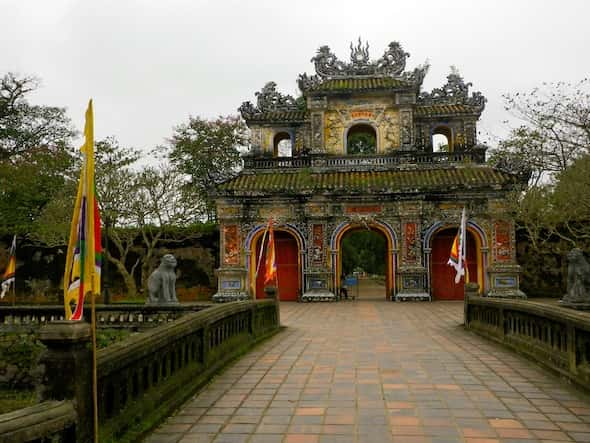
One of the first monuments we came across arriving in Hue
Once in Hue, fifteen minutes' walk from the train station, we found a highly recommended hotel with excellent value for money: Binh Duong I. Spacious, clean rooms with a fan, en-suite hot-water bathroom, TV and Wi-Fi for US$6 a night. Thoroughly recommended.
Hue is bisected by the Perfume River, which divides the city in two — separating the modern part from the old walled citadel. It's a far more appealing place than Vinh: smaller, more intimate, quieter. Until the middle of the last century it was Vietnam's capital, and its streets are steeped in history.
The Perfume River divides the city in two
For better or worse, it's a very touristy city that takes good care of foreign visitors. Restaurants and cafés generally have English menus, and free Wi-Fi is available everywhere. All those conveniences do distance you a little from the real Vietnam, though.
What caught our attention most in Hue was one of its supermarkets. Neither in Thailand nor in Laos had we walked the aisles of a Western-style supermarket. We'd always bought from small family shops, stalls and street vendors, so the wide selection — and reasonable prices without any need to haggle — was a welcome change.
During our days in Hue we enjoyed the local gastronomy and discovered that every region — even every city — in Vietnam has its own culinary traditions. The most famous dish from Hue is known as banh khoai: a small, crispy yellow crêpe stuffed with a stir-fry of prawns, pork and bean sprouts, served with a sesame and peanut dipping sauce and a small plate of vegetables like lettuce, mint, star fruit and/or green banana. The peanut sauce is to die for.
Banh khoai: Hue's signature savoury crêpe
It was in this centrally located city that we started getting the hang of constant bargaining, Vietnamese banknotes and grabbing a small bánh mì for 10,000 dong — a brilliant, cheap snack to tide you over between meals.
Sandwich stalls on every corner
The official currency of Vietnam is the dong — though you'll rarely see coins, since amounts are rounded to the nearest note. The smallest notes are 500 dong, worth barely 1.8 euro cents.
At the time of writing, one euro was worth around 27,500 dong. To put that in perspective: you can eat a baguette for 10,000 dong, or get a full plate at a restaurant for 20,000 dong. But bargaining is essential — without it you might end up paying 20,000 dong for a coffee or 80,000 dong for a beef dish.
On top of that, many prices in Vietnam are listed in US dollars. The exchange rate hovers between 20,000 and 21,000 dong per dollar, and which rate gets used tends to depend on whichever suits the seller.
The highlight of our stay in Hue was ringing in the new year — for the second time, since Vietnam officially observes Chinese calendar festivals. It's curious: both calendars coexist officially and unofficially, and while younger generations increasingly prefer the Western system, they certainly don't skip a celebration.
Among the many traditions the population observes before the new year, a few stand out:
- Flower decorations — yellow flowers or small mandarin orange trees, depending on the family's roots.
- Tables set out in front of homes and businesses, with tools of the trade, food and drink as offerings to the gods.
- The burning of paper and even banknotes in the street.
Offerings to the gods before the new year begins
People burning paper and money in the streets everywhere we looked
We saw in the new year in the rain, with fireworks going off just metres away, inside the old walled city, surrounded by crowds of Vietnamese teenagers. It was a genuinely unforgettable experience — especially since we were celebrating the start of 2012 for the second time.
Vietnamese women sheltering from the rain during Tet 2012
Happy Year of the Dragon!