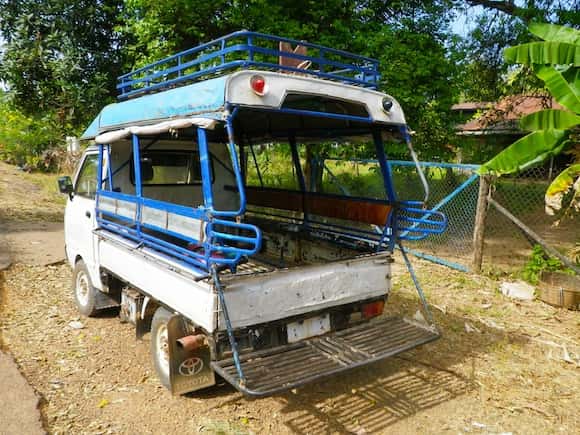
We finally crossed from Thailand into Laos. All told it was a bit of walking, two and a half hours of travel, and two shared local songthaews — those pick-up trucks with benches in the back, kitted out to haul people around.
If you've just arrived in this corner of Isaan, here's how we got to Ubon Ratchathani in the first place: the 13-hour train from Bangkok.
Getting from Ubon Ratchathani to the border
We did the crossing in hops rather than paying for a direct ride:
- Ubon Ratchathani to Phibun by songthaew — 35 baht each.
- Phibun to Chong Mek, the small market town right on the border — 40 baht each.
After a quick look around the market, we crossed the Thai side with no queue at all, then stepped into Laos after paying an extra 50-baht stamp fee. I'd read there was no real way to dodge it, even though we'd sorted our Lao visa in advance back in Bangkok — so I didn't let it wind me up.
Once across, we waved off the wall of van drivers and their hustling and walked on to a further songthaew stand. From there we caught a ride to Pakse for 50 baht. In the end, the whole trip took four hours and three songthaews.
Songthaew or direct bus?
Earlier in the haggling we'd been offered vans for 80 baht each, so if you want a bit more comfort without blowing the budget, it's there for the taking. Honestly, though, in that case you may as well take the direct bus from Ubon to Pakse for 200 baht and save yourself the changes.
Roughly €3 for the day. We spent 125 baht each on transport getting across.
In an ATM I got 2 million Lao kip. I became a millionaire!
Getting cash in Pakse: the ATM lottery
Most of the first ATMs I tried in Pakse wouldn't take my Mastercard — and several wouldn't take Visa either. A few had signs nudging you inside the bank to change money instead, but the fee was 3%, so I politely declined.
Eventually I found one machine that charged 40,000 kip per withdrawal, with a 2-million-kip ceiling. That worked out a touch better — around a 2% fee. A few hard-won lessons for the Lao side:
- Not every card works in every machine. Carry a backup card if you can, and don't assume the first ATM in town will play ball.
- Withdraw the maximum to spread that flat per-withdrawal fee over more cash.
- Carrying a stash of US dollars smooths over the gaps when cards fail — see why you want US dollars when travelling in Asia.
After triple-checking my maths — all those zeros play tricks on you — I decided to become a millionaire and stuffed 2 million kip in "small" notes into my pockets, since the biggest note the machine handed out was 50,000 kip.
Here we hit a fresh exchange rate. With 1 euro worth about 10,400 kip at the time, 2 million kip came to a little under €200.
A quick note on money in Laos
The kip is a heavily devalued currency — so devalued, in fact, that there are no coins at all, just notes. Handy thing to know: shops, drivers, guesthouses and restaurants across the country happily take Thai baht at a fair rate. You can pay in dollars or euros too, but the rate is usually much worse, so spend down your baht here.
One of the first typical Lao temples we came across
Finding a room in Pakse
Dropped at the 2 Km market, we walked the length of Route 13 asking prices at hotels and guesthouses. We ended up at one called Lankham — the best room we'd had anywhere in Asia up to that point: Wi-Fi, hot shower, electricity, a fan, a big comfy bed, spotless, and two free bottles of water a day.
It was a notch above what we normally pay — 60,000 kip — but the cheapest going was 50,000 kip for a dark, grim little room, so the small splurge earned its keep this time.
From here, the road runs deeper into the south of the country. There's plenty to fill a few days — here's what to do in Pakse and the lay of the land for a month in Laos.
Frequently asked questions
Where is the Chong Mek border crossing?
Chong Mek is a small market town on the Thailand–Laos border, east of Ubon Ratchathani in Thailand's Isaan region. On the Lao side it opens towards Pakse, the gateway to southern Laos and the Bolaven Plateau.
Do I need a visa in advance to cross into Laos here?
We sorted ours ahead of time at the Lao embassy in Bangkok. Visa rules and fees change, so check the current situation before you travel — but expect a small fee even with a visa already in hand, and bring some Thai baht in cash to cover it.
Should I take the direct bus or do it in songthaews?
Doing it in stages by songthaew is the cheapest and most flexible way, and it's how we did it. If you'd rather not faff with changes, the direct Ubon–Pakse bus is simple and still cheap. Either way, brush off the van touts on the Lao side and walk on to the proper songthaew stand for the local price.
Can I use Thai baht in Laos?
Yes. Across Laos, shops, drivers, guesthouses and restaurants take Thai baht at a fair rate, which is useful when ATMs won't cooperate. Dollars and euros are accepted too, but usually at a worse rate, so spend your leftover baht first.