There are two genuinely Stalinist countries left in the world, two time capsules complete with a cult of the leader: North Korea and Turkmenistan.
One you can only enter with a guide and a leash. The other hands you a five-day transit visa, drops you in the middle of the desert and wishes you luck. We picked the one you can cross by bicycle.
Five days of visa means four real days on the bike, counting the way in and the way out. A hundred and twenty, a hundred and thirty kilometres a day, a headwind — always a headwind — and a sun that melted the asphalt wherever there was any.
On paper, a beating.
In practice, one of the stretches I enjoyed most in our whole round-the-world bicycle trip. And not for the landscape: for the country.
Turkmenistan is one of the most surreal places I've ever set foot in, and getting deep inside a place that runs on a different logic is exactly what I went looking for.
Over the years I've come to think I wasn't travelling just to see strange places, but to confirm that what we call "normal" is a stage set every country builds for itself.
The border warns you early
We left Iran after two and a half months, and the first thing Turkmenistan did was throw the wind straight in our faces as we crossed the bridge. Ilze started dancing: she could finally take the headscarf off!
Ilze, ditching the headscarf the moment we crossed the border.
The second thing was the customs theatre. A doctor took our temperature with a contactless thermometer and noted it down in a table, next to our passport details.
I never understood what they were looking for, or whether they'd measure us again on the way out to check my fever hadn't risen above the regulation limit.
We paid twelve dollars "to the bank", declared in writing every last banknote we were carrying, and rode the bikes up the ramp — pedalling — right into the building.
The last official, in impeccable English, interrogated us:
— Are you carrying anything illegal? Drugs, an AK-47?
— No.
— And should I trust you?
— Yes.
— Okay.
It was 10:20 in the morning. We were in.
Four days of headwind
You don't choose the route: the visa does. Ours ran from Sarakhs to the Uzbek border through Mary, nowhere near Ashgabat or the Darvaza gas crater.
Turkmenistan is a desert, but the first surprise is how green it is: a network of canals moves the water around and lets them grow crops almost anywhere.
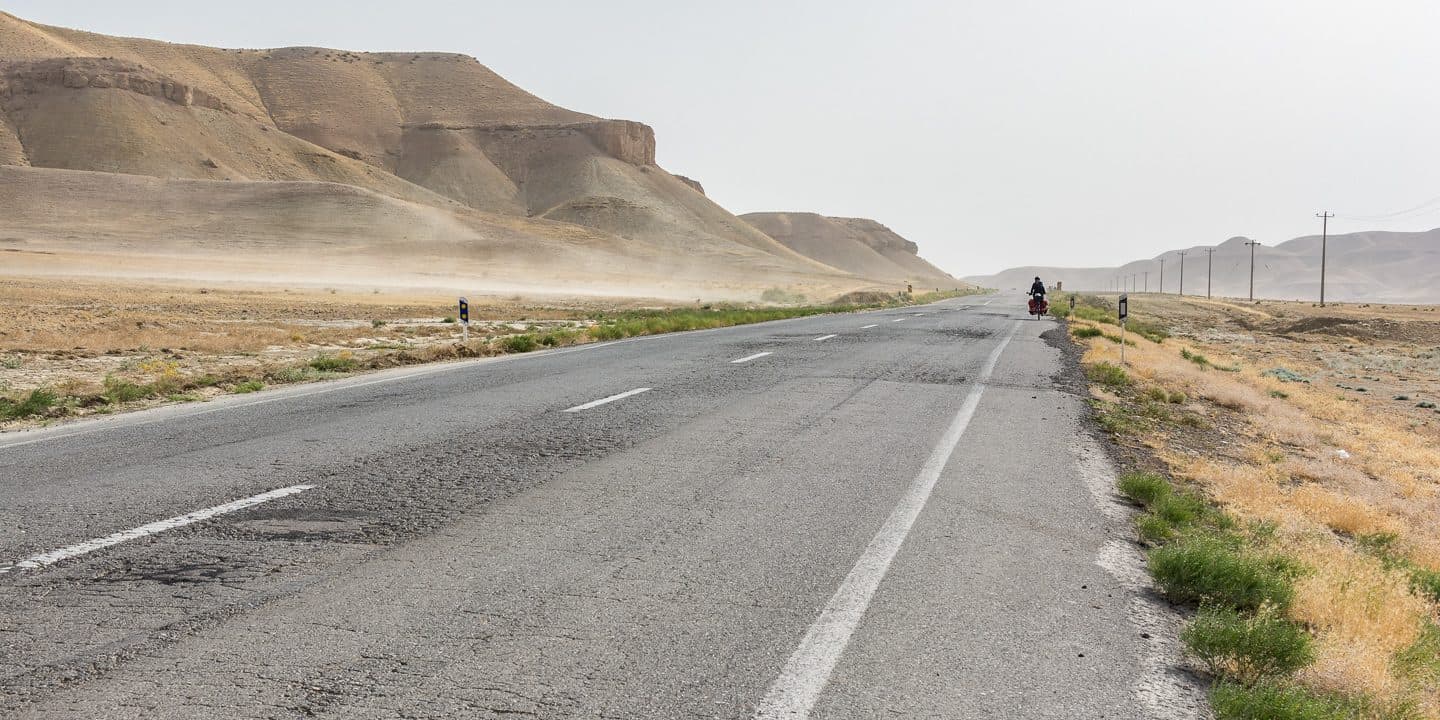
The second is the state of the roads. Calling them roads is flattery: potholes, dust and rocks, in that order.
By the first day, two of our eggs had already broken inside the panniers — after months of carrying them without a scratch.
The first night I lay sweating inside the tent, waiting for a coolness that didn't arrive until two in the morning.
We bought melons and watermelons, one manat each — the local currency, about 25 cents at the time — from sellers wrapped head to toe, face included, with two little holes for the eyes.
We ate in the shade of the first tree that appeared and went back to fighting the wind, which never let up.
When it won, we hitchhiked trucks without getting off the bikes: we'd watch them grow in the mirrors and wave them down.
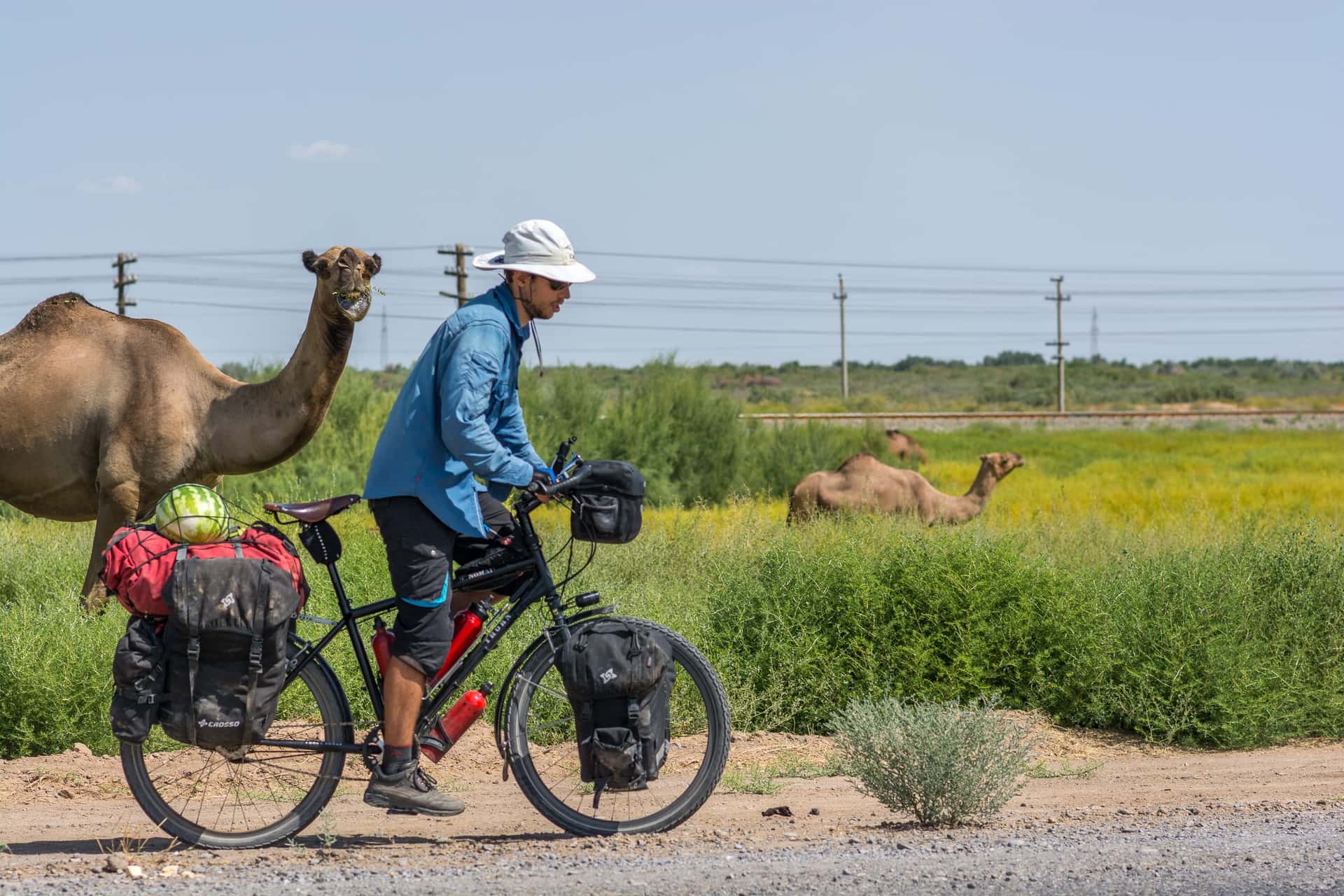
On the roadside, camels grazing like it was nothing.
Watermelon on board. In the background, the usual camels.
Everyone has gold teeth. And nobody asks how old you are: they ask the year you were born.
— Year?
— Twenty-seven.
— Year, year.
Prices were a hieroglyph, because people still did the maths in an old currency worth five thousand times less: I asked what I owed, they typed 31 into the calculator, and I ended up paying 6 manat. They even gave me a discount in banknotes that no longer existed.
After two and a half months in mandatory-headscarf Iran, Turkmen women were another planet: long, straight dresses in bright colours, and many wearing a stiff headpiece that held their hair upright over their heads.
Everyone kept asking whether we were married; the day Ilze got tired of lying and said no, she got a round of the funniest questions: are you going to sleep in the tent together? and won't he do anything to you?
And then there were the photos. At every stop people crowded round to photograph us: with sunglasses, without sunglasses, hugging, on the bikes, holding the bikes.
We felt like fairground monkeys — but well-paid ones: every session ended with our bottles refilled with cold water to keep pushing into the desert.
"Turkmenistan is great"
The cult of the leader, in gold. The statue is literal.
We're the interrogating kind. In every country, anyone who could scrape together some English or Russian got a grilling: how does this work, who's in charge, what's allowed and what isn't.
In Turkmenistan the harvest was historic — a young guy who'd studied in Turkey and treated us to ice cream and pomegranate juice, several truck drivers, a Russian couple of Tatar origin.
Out of those conversations came a kind of unofficial manual of the country. I haven't verified it, I can't, and some of it smells like urban legend. But it's the Turkmenistan the Turkmen themselves describe when you get them talking, and that version already says plenty:
- "Turkmenistan is great" isn't an opinion, it's the official motto. Literally. And the only national TV channel is dedicated to repeating it: people explaining how well everything is going. Anyone who can watches Turkish or Russian TV by satellite.
- They call the president Voldemort. Quietly, because speaking ill of him or of the country is a crime. When they need to tell them apart, it's "old Voldemort" or "the new one".
- There are no illnesses in Turkmenistan. If you fall ill, you go to the doctor and get sent home with vitamins. You can't be sick: health here is perfect.
- Cars older than five years are banned, and so are tinted windows. The roads make you want to cry, but everyone drives a brand-new car: wouldn't want the country looking less modern than it claims to be.
- The old president wrote a "holy book" about the greatness of Turkmenistan and of himself. It was compulsory study at school. The new one writes about medicinal plants. World geography and world history, on the other hand — better not to know.
- Nobody scores below a 4 at school. Not because they've solved education, but because they've solved the statistics.
- Almost everything is paid for with bribes: nursery, driving licence, university. Sixty thousand dollars in bribes to get into a degree, according to them.
- The day the president visits a city, people form human corridors to welcome him and they scrub the avenues he'll drive down with soap.
- The new president once fell off his horse. The solution was to confiscate the phones and cameras of everyone present and erase the evidence. Officially, the president does not fall.
I could go on — the melon has its own national holiday, little girls have to wear a certain headpiece to school because a president once found it charming, the opposition "disappeared off the face of the earth" — but you get the idea.
And in the end the most Turkmen thing wasn't any single oddity, but the one logic behind them all: it didn't matter whether something worked, it mattered that it looked like it worked.
Sweeping the avenue: what matters here is that it looks like it works.
Wrecked roads, but new cars. Useless doctors, but a country without illnesses. Schools where nobody fails, but pupils who aren't allowed to study world history. All window dressing. And behind the window dressing: dust, bribes, and normal people trying to get on with their lives.
The people are not the regime
And yet.
Behind all that nonsense, the Turkmen were some of the most generous people we met on the entire trip. We stopped to buy a couple of tomatoes and ended up with four in hand and our money handed back — there's no small change there; you buy by the bucket, not by the kilo.
A seller stopped us in the middle of the road just to gift us a watermelon to carry on top of panniers that were already full to bursting. We ate the whole thing that same afternoon in the shade of a roadside motel; Ilze was so full she couldn't move.
Truck drivers who braked only to hand us cold water in the middle of that furnace. The guy from Turkey who sat us down in the shade with an ice cream and a pomegranate juice out of pure curiosity, just to talk to two foreigners on bikes.
The people, who are not their government.
I already wrote it about Iran: the people are not their government. Few places make it as obvious as this one.
You can live in the most closed, most surveilled country in the world and still open your door to two strangers pedalling past.
Ten years on, I don't remember how many punctures we had or where we slept each night. But I do remember what it felt like to pedal through a country where everything seemed like an official joke nobody was allowed to laugh at out loud.
We crossed Turkmenistan exhausted, sunburnt and with a headwind all four days. And I'd do it again tomorrow — though that's easy to say when your relationship with a dictatorship lasts five days and ends at an exit border marked on the map.
Some people say you shouldn't travel to countries like this. I'm not going to tell anyone not to go: dictatorships fascinate me, and I'd rather walk in with an open mind, look at everything, and then say it all, loudly — the good and the deranged.
Turkmenistan is great. At least that's what they say.