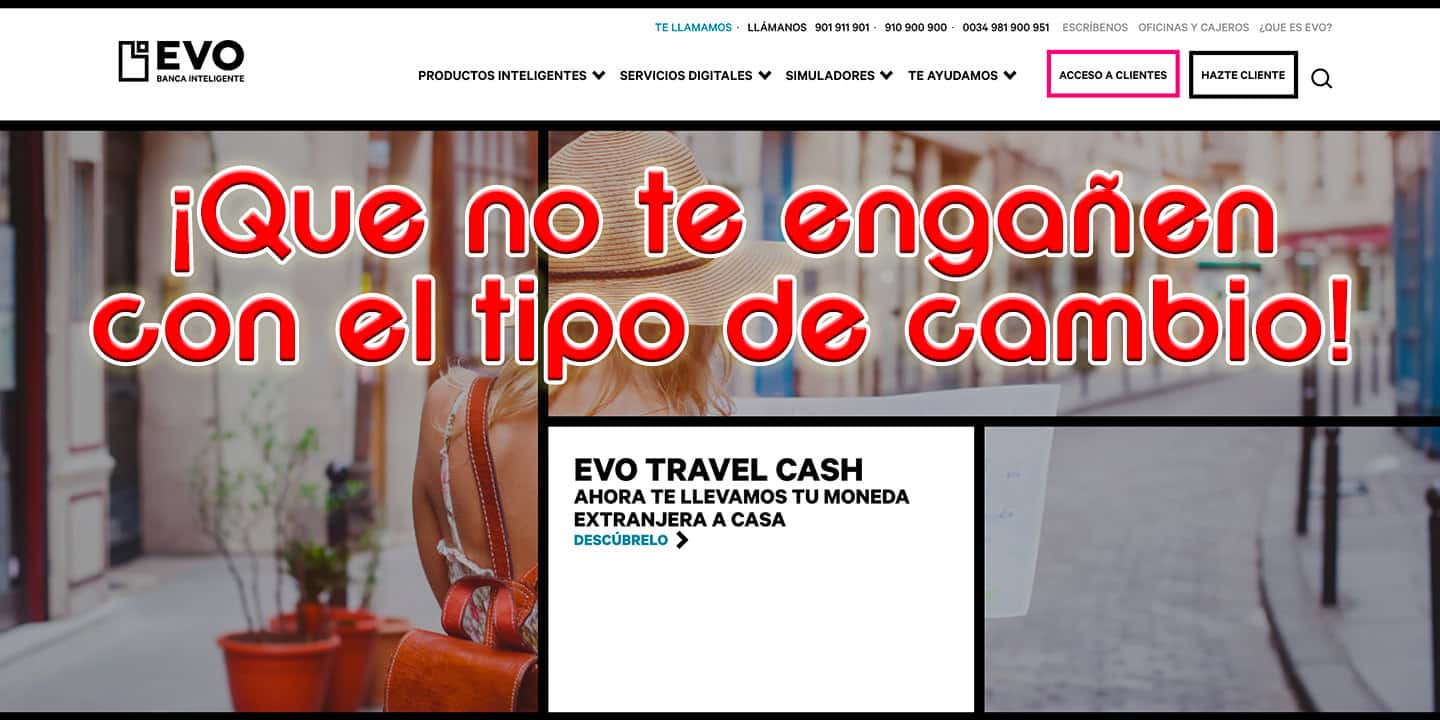
Many of you opened a bank account with EVO Banco over the past few years because they offered the best conditions for withdrawing money abroad. Then, in the summer of 2017, that quietly stopped being true — so I sat down to work out exactly how badly, and which cards were worth switching to.
(The bank names, limits and rates below are a snapshot from 2017, so treat them as a worked example rather than today's gospel — card terms change constantly. The principle, though, is timeless: always know whose exchange rate you're actually getting.)
If you check the messages inside your EVO Banco account you'll see they sent a notification warning that in a couple of months they'd stop using the standard exchange rate and switch to their own. Then, without further warning, they applied this new policy early — from 11 July they started using their own exchange rate instead of Visa's.
Of course, despite bombarding us with emails for every little thing, this wasn't important enough to merit a proper notification. Far better to bury it in account messages that practically nobody reads. And even better to apply it ahead of schedule and catch everyone with their trousers down while they're on holiday.
During this period I've been trying to find their new exchange rates to compare them with Visa's and see just how much they'd inflated the cost of conversion — if they weren't going to hike it, they wouldn't have bothered changing the system.
The amusing part is that their website still advertises zero commission when using your card in any ATM worldwide: "Abroad we don't charge you a single cent for cash withdrawals on your debit card. No matter the country." Ha.
Update: Customers visiting branches in person are being told no commission is charged. ONLY when the customer insists and specifically asks whether they're applying Visa's official rate or their own does the bank admit it. Even then they downplay it, saying it's "only a little bit" and that there are still no commissions.
I eventually found the rates, buried in their website. You have to navigate to: What exchange rate will apply if I make a card transaction in a currency other than euros?
And once there, scroll down to the last points, where it says: "Exchange rates for Visa cards from 11 July are published from 8pm — to check them click here." This link leads to the PDF that should be updated daily with recent exchange rates.
Update 1 August 2017: They're no longer publishing full PDF lists and you have to search one currency at a time.
With the rates in hand, the next step is to compare them with Visa's — which is what we were getting until now. To do that, go to VISA Europe's website.
EVO Banco vs Visa — the exchange rate comparison
For brevity I'll look at a selection of currencies, not all of them.
As of 18 July, the comparison is as follows:
- The US dollar has a markup of 2.91%
- The British pound has a markup of 3.17%
- The Swiss franc has a markup of 3.46%
- The South Korean won has a markup of 2.93%
- The Canadian dollar has a markup of 2.83%
Up to here, relatively normal. EVO Banco has stopped offering the official rate and is no longer interesting — doing so without adequate warning — but the rates seem in line with other banks. Right?
NO. Keep reading.
- The Hong Kong dollar has a markup of 7.08%.
- The Thai baht has a markup of 15.20%!
- The Icelandic krona has a markup of 18.11%!
- The Serbian dinar has a markup of 19.91%!
- The Japanese yen has a markup of 28.73%!!
- The Albanian lek has a markup of 31.66%!!
- The Angolan kwanza has a markup of 88.77%!!!!
What kind of scam is this? Where did they get these numbers?
I honestly don't know how they calculated these figures, but it looks a lot like simple rounding. The problem is that for each currency they cut off at an arbitrary decimal place, creating some truly horrific exchange rates.
To top it off, there are actually some currencies where EVO's rate is better than Visa's — so don't burn your cards just yet, because in a handful of countries it might still be worth using EVO Banco.
That said, make sure you check the rate on the day itself, since everything can change overnight. Once they realise they've made a mess of it — and that they're losing money on some currencies — I'd expect someone to get the sack and those rates to be corrected.
- The Moroccan dirham offers a saving of 1.83% on the exchange rate.
- The Argentine peso offers a saving of 3.85%.
- The Indonesian rupiah offers a saving of 8.68%.
- The Ukrainian hryvnia offers a saving of 10.85%.
- The Mongolian tugrik offers a saving of 17.85%!
- The Indian rupee offers a saving of 26.44%!!
Update: A few days after writing this post they increased the number of decimal places and/or reduced the aggressive rounding, particularly on the currencies that were giving a favourable rate. There are no longer any favourable rates — every one I've checked is now worse than Visa's and Mastercard's.
Be very careful and don't trust EVO Banco's exchange rate. It has gone from being the best Spanish option to an absolute lottery.
The wider lesson is the one I keep banging on about: the enemy isn't just commissions, it's the exchange rate hidden behind them. A card can shout "no fees!" and still quietly skim you on conversion. I unpack how that trick works — and how to dodge it at the cash machine and the card terminal — in stop paying currency exchange fees when you travel.
What are the best cards for travel?
EVO Banco: eurozone only
If you're travelling within the eurozone, you can still use EVO Banco for fee-free ATM withdrawals — but be careful when withdrawing cash in European countries whose currency isn't the euro.
ImaginBank: eurozone only
Similarly, ImaginBank offers fee-free ATM withdrawals within the eurozone, and it's also a completely free account. Outside the eurozone, fees apply.
Abanca: under-30s only
If you're under 30, you can open an account at Abanca with the NX Mastercard — no fees, official exchange rate. Just be aware they have a fairly aggressive policy of trying to push other products on you when you open the account.
Revolut: RECOMMENDED
The most accessible option is Revolut. They ship worldwide and it's a Mastercard prepaid card, meaning you top it up from your own debit card or via bank transfer.
The app works perfectly, as does the card itself. The exchange rate is Mastercard's official one, which tends to be slightly better than Visa's, though it varies by country.
They used to send the card for free, but recently started charging £5 or €6 for the physical card.
There's a cash withdrawal limit equivalent to £200 per month, but no limit on card payments in shops or online.
Monzo: RECOMMENDED if you have a UK address and phone number
There's another similar card called Monzo, but it's only available if you have a UK address, and can only be topped up in pounds. You can of course use a friend's address to receive it. A UK phone number is probably also required — when I signed up I used my British number directly, so I can't confirm this.
That said, if you can receive it at a UK address, you can top it up from Revolut, which in turn you can load with euros.
Monzo is also a Mastercard and uses its exchange rate, so it's similar to Revolut.
It has a higher cash withdrawal limit: £1,000 per month and £250 per day, with an annual cap of £3,000. Like Revolut, there are no limits on card purchases in shops or online, though individual transactions over £1,000 aren't accepted.
Monzo card delivery is completely free — to UK addresses.
Ferratumbank: New and RECOMMENDED
Update 1 August 2017: There's a new bank account that could be interesting: Ferratumbank. They use the official Mastercard rate for fee-free cash withdrawals worldwide, have no conditions, and let you hold accounts in different currencies. They allow up to 4 free ATM withdrawals per month. Sign-up is very simple and quick.
Bear in mind they apply a less favourable rate when moving money between your own accounts in different currencies — but not when using the Mastercard in ATMs.
These are currently the only cards offering official Mastercard rates with no fees.
N26: constantly changing, now eurozone only and with conditions
N26 was popular for a while, but after repeatedly changing its terms it's no longer worth it. They require you to make a certain number of transactions per quarter and only offer free withdrawals within the eurozone.
Frequently asked questions
What makes a "good" travel card?
Two things, and people only remember the first: no withdrawal/payment fees, and — just as important — the network's official exchange rate (Visa's or Mastercard's), not the bank's own marked-up one. A card that ticks the first box but quietly fails the second can cost you more than a card with a small honest fee. Always check both.
What is the bank's "own exchange rate" and why is it worse?
Instead of passing on the wholesale rate Visa or Mastercard sets, the bank substitutes its own, padded number — sometimes by a few percent, occasionally, as I found with EVO, by absurd double-digit margins on minor currencies. You won't see a separate "fee" line; the markup is baked into the rate, which is exactly what makes it so sneaky.
How do I avoid getting a bad exchange rate abroad?
Pay and withdraw in the local currency, never the "convert to my home currency?" option the ATM or card machine offers — that's Dynamic Currency Conversion, and it's almost always a rip-off. Use a card that applies the Mastercard or Visa rate, and carry a small stash of US dollars as a backup for places with no decent ATM.
Are prepaid travel cards like Revolut or Monzo worth it?
For most travellers, yes — they generally apply the Mastercard rate with no conversion markup, and you only top up what you need, which limits your exposure if a card is lost or skimmed. Just keep an eye on the monthly fee-free withdrawal limits and the small print, because, as this whole saga shows, card terms get rewritten with very little warning.
Should I still trust EVO Banco?
Inside the eurozone it can still do the job for fee-free euro withdrawals. Outside it, the trust is gone — check the rate on the day, every time, and assume nothing.