Night is falling somewhere in Uzbekistan and we're knocking on a stranger's door. Again.
I knew the script by heart:
— Hello! We're travelling by bicycle and we can't find anywhere to pitch our tent. Could we put it up in your courtyard?
And the answer, night after night for almost a month, was always some variant of the same thing:
— A tent? But we have a house! Come in.
That's how we crossed Uzbekistan: courtyard to courtyard, eating and sleeping almost every night with a different family who an hour earlier had no idea we existed.
There was just one catch: almost none of those nights were legal.
In 2015, Uzbekistan was a textbook police state, and its rules for tourists left no room for doubt. It took me years to understand what those rules were really for: not to be followed, but to put a price on getting caught. Real life, as you'll see, was off doing its own thing.
The country of paper slips
We'd just come off the five-day sprint across Turkmenistan, so a 30-day visa — issued in Tehran, like almost every Central Asian visa — felt like luxury: border to Bukhara; then Samarkand, the Kamchik pass and the Fergana Valley, out to Kyrgyzstan through the valley's northern corner.
We never went anywhere near Tashkent. Nothing personal: the police made it unappealing, and Samarkand, Bukhara and the valley promised a lot more than a capital city. Mind you, we only ever saw the madrassas of Samarkand and Bukhara from the outside, without going in. Our monuments were elsewhere.
The Registan in Samarkand, seen the way we saw everything: from the outside.
Ten years ago, writing from Chengdu, I called this stretch "the marathon of dodging the police for lack of hotel registrations". I owed you the story.
The rule went like this: tourists sleep every night in a licensed hotel, and every hotel hands you a slip with its stamp. Your registration. On the way out of the country, they can ask you for the whole collection, night by night.
Among travellers there was a finer reading: you only actually had to register if you spent more than 72 hours in one city — as long as you could prove it. And two loaded bicycles were walking proof: nobody crossing a country on pedals can sleep in a hotel every night.
And if they stopped you without slips? That's where it got serious: they could take you in for questioning by the secret police — a matter of days, people said —, send you off with a fine in the thousand-dollar range — 2015 dollars — and, if you couldn't pay it, deport you.
My plan was legally watertight: don't get caught. And if things went sour at the exit border, deportation didn't scare me much either: they'd be deporting me to the country I was already heading for.
The rule gave you 72 hours before your first registration, and we used every last one. The first night we camped in somebody's field with other cyclists riding the same road: shared dinner, something to drink, tents lined up between the furrows. One of those good road nights.
By the second night we were having dinner with a family who'd scooped us up off the road as we passed. And they took our registration problem personally: they tried to sneak us into some hotel for free, or close to it, just for the stamp. The hotels didn't bite.
So on day three, in Bukhara, we paid 16 dollars for a hotel with breakfast, stamp included — and, while we were at it, a night to ourselves.
It was the only slip of the entire month.
Money meant more theatre. On the way in you declared every last dollar in writing, because taking more currency out of the country than you'd brought in was forbidden. And then there was the exchange rate: the official one, and the street's black market, which paid nearly double. A hundred dollars got you 445,000 som at the time, in thousand-som notes: 445 banknotes, which ended up stuffed into my handlebar bag. From then on, opening it without money flying out was a precision manoeuvre. Small bills traded worse, by the way: even the black market had its rules.
A hundred dollars at the street rate: 445 thousand-som notes. Rubber band included.
My favourite detail: internet was priced in dollars at the official rate, so the 10-dollar data pack cost 6 if you paid with street som. Even the megabytes had an official price and a real one.
And the crown jewel: a SIM card cost 2,000 som, but if you, the foreigner, bought it yourself, it came tied to your hotel registration: your booking ran out and your SIM dropped dead. The fix, as for almost everything in Uzbekistan: ask a local.
Registration, declarations, two exchange rates, a SIM on a leash: all the country's paperwork was asking the same question — where are you, and how much are you carrying.
"Hello, hello"
That left the police checkpoints, of which Uzbekistan has many, packed close together. At every one, an officer would watch me roll up and give me the signal to stop.
And I'd wave.
— Hello, hello!
And I'd keep pedalling, wearing my very best face of not understanding a thing. They'd gesture harder; I'd wave harder. Nobody ever came after us. I don't think any manual covered what to do about an idiot on a bicycle who answers a stop signal with a wave.
"What do you need a tent for?"
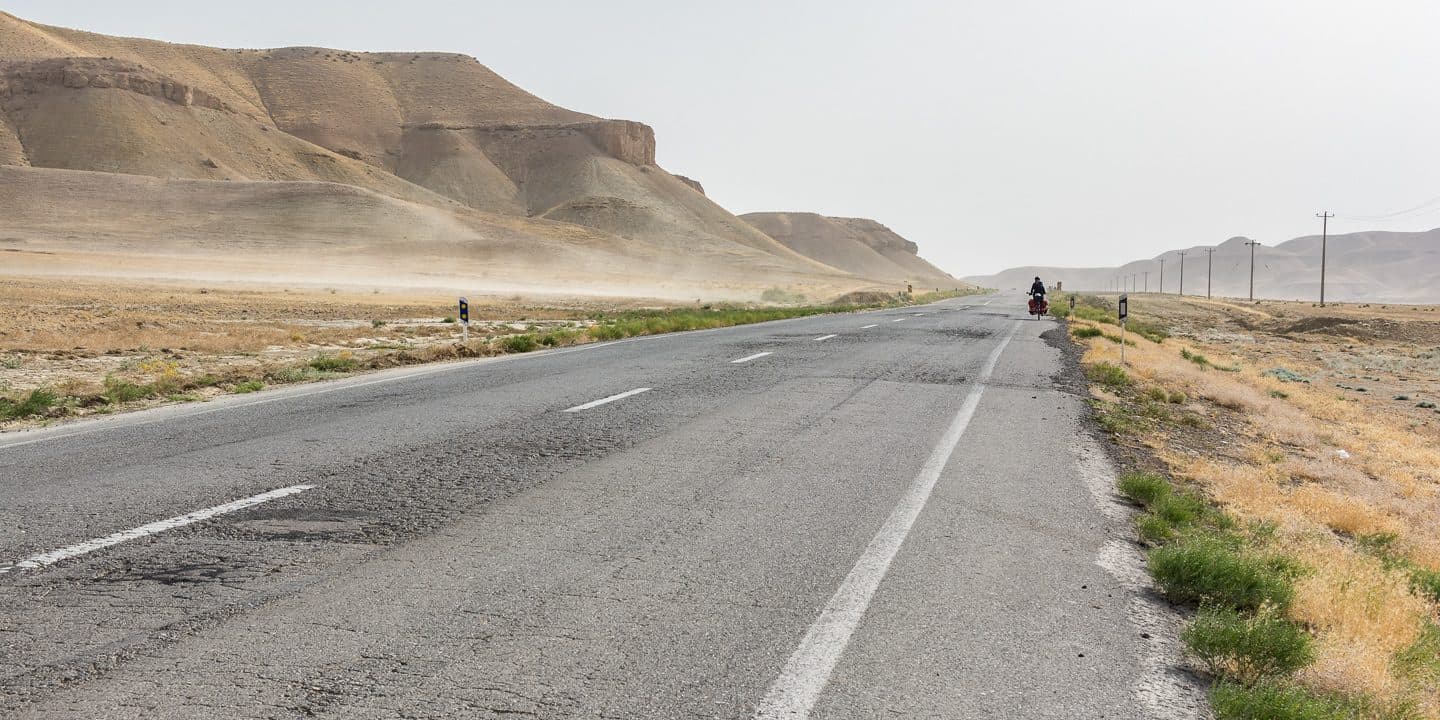
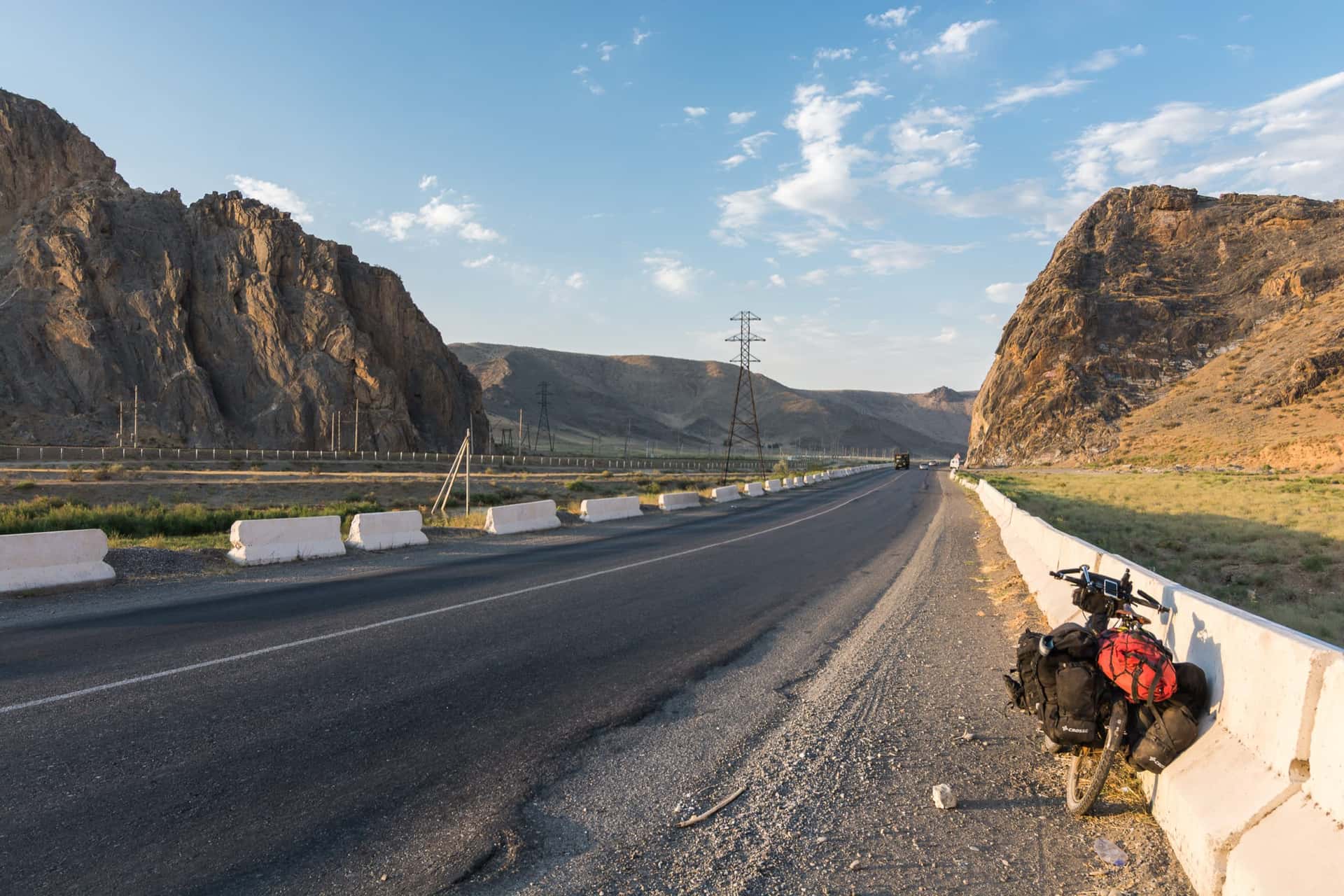
The "we can't find anywhere to pitch our tent" line wasn't a trick: it was true. Uzbekistan is flat, open and farmed down to the last square metre; there is nowhere to hide a tent. And the police finding us camped was exactly the conversation I didn't want to have.
Nightfall in Uzbekistan: flat, open, and not a tent-hiding spot in sight.
The houses, on the other hand, were built for the opposite: nearly all identical, a walled square with its courtyard inside. We'd knock on any door, deliver the script, and from there the evening organised itself: tea, dinner with the entire family gathered round, a long after-dinner conversation with Ilze interpreting the Russian, and back on the road in the morning. In almost a month, the tent came out of the panniers three times — the cyclists' night, one night in the middle of nowhere, and one halfway up the Kamchik pass. Every other night, we slept inside somebody's home.
One of the families who opened their door to us. Everyone in the photo, under one roof.
Along the road, watermelons, tomatoes and grapes handed over for free at any stall, and fresh patir bread, flaky like a croissant. And alone — properly alone — we didn't spend a single moment: the average Uzbek comes fitted with a curiosity that will not leave you be. Luckily for us.
Watermelon aboard, again. Along the road they wouldn't let us pay for them.
By then our lips were already cracked — sun, wind and sand ever since Turkmenistan. But Central Asia's serious ailment was served in a glass: fresh-drawn, unpasteurised milk, in every house, no questions asked. To a European stomach it landed like a declaration of war.
Some Argentinian cyclists riding the opposite way had prophesied it all, laughing, with a warning about the region's toilet paper: rough as sandpaper when it existed, newspaper when it didn't. A few weeks later the joke had become a medical report: every traveller we crossed paths with that summer was going from one bout of diarrhoea to the next, and the region stood ready with its one-square-metre sheds, a hole in the floor and that sandpaper waiting inside.
We made two reforms: proper paper the moment it showed up in a shop, and saying no to the milk, the butter and the fresh cheese, however much warmth came with them. We knew how the story went.
Out of those long dinner conversations came the country that wasn't in the rulebook: that in Soviet times there were factories and people at the bottom lived better; that plenty of kids didn't go to school because their parents couldn't cover the transport and the meals. None of it I ever verified: it's the version told by the people who sat us at their table. It was good enough for me then, and it's good enough now.
One of those tables: tea, bread and fruit straight off the vine overhead.
One of those nights, the invitation came with a surprise: a neighbour's funeral — and I was taken along, with the men. It didn't take me long to work out my role: turning up with the foreigner raised the household's standing in front of the whole village. The women had been cooking since four in the morning; the men were on the vodka by six.
Great way to start the day.
The two cyclists of the Fergana Valley
In the Fergana Valley, a car overtook us, braked, and out stepped two older men smiling like they'd known us all their lives.
And in a way they had: many years earlier they'd crossed Iran — where we'd just come from — on plain old bicycles carrying next to nothing, sleeping every night in whichever mosque would take them in. They knew exactly what it was to arrive at a door at nightfall. Watching two loaded bikes ride past had made their day.
They invited us to their house, of course. Their house was 80 kilometres away.
It was late and we weren't going to make it, not a chance — but that didn't slow them down: they drove on ahead, stopped at a restaurant and left instructions for us to be fed and given a place to sleep. Then they doubled back just to explain where to stop, what to say, and how to reach their house the next day.
The next morning we met them again halfway there: they'd driven out to find us. In case we tried to escape.
A very bad wife
We stayed at their place a couple of days, and they were equal parts comedy and exasperation. Especially for Ilze.
Our host was a man thoroughly convinced of every one of his opinions — not a rare trait in Uzbekistan. We barely saw the women of the house at all: they'd appear with a tray, set it down and vanish.
The conversation ran in Russian, so Ilze translated. And the man, instead of asking her what she thought about things, would ask her what her husband thought — they'd married us off all by themselves; we just played along whenever anyone asked.
— And what does your husband think about this?
Until Ilze snapped:
— You can ask ME! I'm the one talking to you!
The room they gave us was enormous, with one floor bed in one corner and another in the opposite corner. And a very serious warning: in Uzbekistan, guests cannot have sex in someone else's home. It is very wrong. We took note with all the seriousness we could manage.
Since we were staying two days, laundry was due. We asked where, they showed us a room with running water and a stone counter for scrubbing, and off we went, the two of us, each with our own pile. Before long the parade began: women peeking round the door, watching, evaporating. The foreigner washing his own socks: the show of the week.
That evening, our host turned solemn with Ilze:
— I have to tell you something. You are a very bad wife.
— Excuse me??
— You make your husband wash his own clothes!
— And why wouldn't he? Besides, in my country a washing machine does this!
There is no record of us changing his mind. Ilze stayed offended for a good long while.
The small border
To leave the country we skipped the main border crossing, the Osh one, at the far end of the valley: we went out through Uchkurgan, a small post in the northern corner, light on traffic, where border checks happen at a much calmer pace. Good call.
And on top of that, we got lucky. While we were crossing, one of those expedition-looking 4x4s pulled up — British? European; ten years on I honestly couldn't tell you — and they spoke no Russian, and the officials spoke nothing else. Ilze ended up as the border post's official interpreter, and suddenly we were the crossing's favourite foreigners.
Then came the serious part: the money. You couldn't take out more currency than you'd declared on the way in, so I declared I had spent absolutely everything. A lie. The banknotes travelled well hidden. The official, far from suspecting anything, congratulated us for spending it all in his country.
And finally, the hotel slips. There were no slips.
— Where have you been sleeping?
— In our tent.
They thought about it for a moment and decided that two foreigners without a dollar on them offered no fine worth collecting and nothing worth arguing over. Stamp, and on to Kyrgyzstan.
On the other side, our last 100,000 Uzbek som became 1,300 Kyrgyz som. From som to som, easy as you like.
Although ten years on, let's be honest: dodging that police force was easy with a European passport in my pocket, when the worst that could happen to me was being sent to the country I was already going to. For the people of the courtyards, this wasn't a one-month game. It was their country.
What stays with me from Uzbekistan isn't the checkpoints or the fear of the fine: it's the courtyards. The teapot, the space made at the table, the whole family watching you eat, the script of every nightfall — which I still know by heart.
The State never found out where we slept. Its people knew every single night.
And if you ever cross Uzbekistan with a tent in your panniers, you already know what you'll hear at the first door you knock on:
— A tent? But we have a house! Come in, come in!