We needed a break. Winter had literally closed in around us, cold and snow on all sides, and all we wanted was to lock ourselves inside four walls for a while — catch up on projects, rest after more than a year on the road.
So what to do? The original plan was to head to the capital, Tbilisi, rent a room, and spend a couple of months disconnecting. Write, sort through photos, and give our backsides a break from the saddle.
As I turned the idea over, Ilze needed to go to Latvia to renew her passport — and visit her family for a month while she was at it — and there are cheap WizzAir flights from Georgia to the Baltic states (and other parts of Europe).
Either way, first we had to get to Tbilisi. We crossed the Georgian border without incident but not without loss. Not luggage — my girlfriend. I lost Ilze. Ignoring the border guards' instructions, she headed straight for the truck queue while Billy — a Swiss girl we'd met in Turkey and had been travelling with for a few days — and I followed instructions and went to the pedestrian crossing.
The new stamp in our passports lets us stay in Georgia for 90 out of the next 180 days. No visa, no prep required — you can even enter Georgia on a national ID card without a passport.
Warmshowers in Georgia
On the other side of the border Billy and I met up with our Warmshowers host, Teimuraz and a friend of his, whom we'd arranged to cycle with to his place in Batumi. But first we had to wait a good while for Ilze, who'd been offered wine and a bed by various border guards during her long and solo crossing.
We pedalled at a leisurely pace, talking the whole way with our new companions over the next 20 kilometres to Teimuraz's house, where Jekaterina — his wife — had prepared a delicious dinner. We were promptly held hostage for a week. Every morning we'd say we should get moving, take advantage of the good weather and push on towards Tbilisi, but before we'd even finished the sentence Jekaterina would grab us by the arm and tell us we couldn't leave — that we were part of the family and she still had plenty of dishes to cook, and we couldn't go without trying them all.
How could we say no? A week later, bellies full and panniers stuffed with enough food for several days, we headed for Tbilisi. Not without stopping at the house of Teimuraz's brother in Kutaisi, another Georgian city on our route.
Cycling from Batumi to Tbilisi
In winter the options are more limited than in summer. The quieter mountain pass was closed, forcing us onto the only other road to the capital. There was barely any alternative — the odd muddy track to avoid traffic (which wasn't excessive), and a back road on the last day.
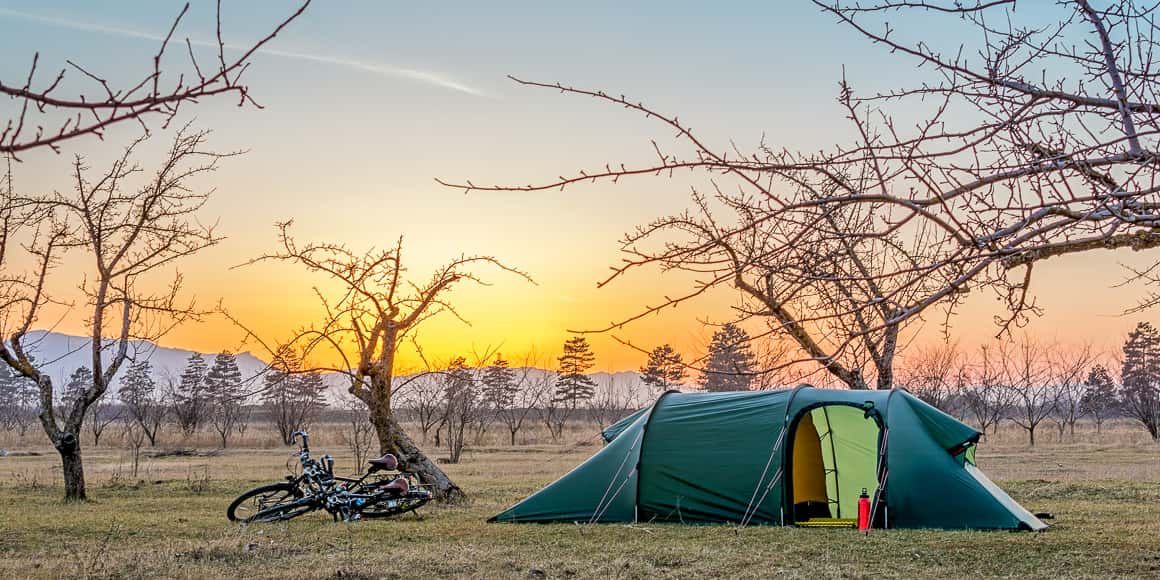
During our final week of riding before the well-earned winter break, we camped every single night, missing Jekaterina's cooking but enjoying the freedom and the nature around us.
Some stretches were literally uphill — but we took it easy, stopped whenever we felt like it. The perks of having no rush and no constant rain battering you, unlike the month before.
Food in Georgia
The national dish is khachapuri — essentially a stuffed bread. The dough is filled with cheese, and when it comes out of the oven with the cheese melted, a raw egg (or several) is dropped on top to cook on the cheese. That's the most famous version, but there are others: without egg, with hard-boiled egg, with a minced meat filling, and plenty more.
Georgian food in general is heavy and shares a lot with other former Soviet countries in terms of ingredients. It's not spicy. And almost everything revolves around bread. Bean-filled bread, meat bread, plain bread.
The other star of Georgian cuisine is khinkali — enormous dumplings filled with meat, vegetables or mushrooms, similar to what you find across Eastern Europe. What makes them different is the way you eat them. You bite in, suck out the broth, then eat the rest of the dumpling. If they go cold, no problem — fry them in a little oil in a pan and you've got another dish entirely.
Wine in Georgia
Every social occasion in Georgia revolves around alcohol — wine and vodka. Drinking with the people around you is just part of the culture, always, at all times. Wine is drunk by the glass, not by the sip. And any container will do as a glass — the bigger the better. In polite company at a table it's a relatively modest glass (thank god, given you have to drain it in one go), but with friends or after a few rounds the vessels get more creative: vases, bowls, horns… anything goes.
The advantage of drinking wine in Georgia is that almost everyone has family in the countryside with vineyards, so they make their own wine — and vodka — and the house is full of bottles (or jerry cans). Did I say advantage? The disadvantage is that the party doesn't end until everyone's flat on the floor drunk, because the alcohol never runs out. Never.
The strangest part of all is the toasting culture. Typical of the Caucasus, and especially Georgia, is the custom of drinking after a toast. Every toast, everyone drinks. And there are toasts constantly. But these aren't quick "cheers" jobs — each toast is a lengthy reflection on family, food, health, or friendship. One toast, one glass, then straight into the next toast. And so on until the wine runs out — which, as established, it never does.
They say there are no alcoholics in Georgia, because an alcoholic is someone who drinks alone — and in Georgia, no one drinks alone. There's always someone to drink with, so becoming an alcoholic is impossible. That's one way of looking at it.
Working in Tbilisi
Once in Tbilisi, I organised photography workshops and courses, mainly aimed at other expats living in the Georgian capital. Between Couchsurfing hosts, friends we made along the way, and students at the university where I gave a talk, there was no need to rent a flat or room for just ourselves — especially since I ended up spending a full month there alone — and the winter break ended up in the black.
The money from the workshops covered almost all the expenses I'd accumulated since we left England in January 2014. Or it paid for a new GoPro, a few hard drives, all the Central Asian visas, and a bit more besides. Enough fuel to keep going for another good stretch.