Koh Thonsay gets its name from its rabbit-like silhouette — at least according to the Cambodians who named it. It sits 4.5 kilometres off the port of Kep, in southeast Cambodia near the Vietnamese border, and covers about 2 square kilometres — small enough to walk from one end to the other.
To get to Rabbit Island we took a boat for $7.50 each, return ticket. You can charter a boat for 6 people for $20, but only if you're coming back the same day. We wanted to stay several nights, so we took the standard service.
The island is almost entirely uninhabited — just a handful of fishing families live on Koh Thonsay, several of whom have switched businesses since tourism arrived. The main beach has a cluster of bungalow operations owned by island residents. For that very reason, arriving without paying tourist prices is basically impossible.
Leaving the port of Kep behind
Fisherman preparing his nets
There's no electricity on the island except for a few hours around sunset. Before heading out we went to the Kep market and bought a kind of Cambodian griddle-pot, planning to cook our own food using our stock of noodles, eggs, vegetables and water.
During our days on Koh Thonsay we made beach fires and cooked over the embers using the pot. We also brought our own drinking water, since past experience on islands had taught us to expect extortionate prices for anything potable.
Accommodation is available for $5, though it's worth comparing — room sizes, bed types and bathrooms vary enormously. We ended up paying $6 for three nights as all the $5 bungalows were taken.
Bungalows on Koh Thonsay
Food is a bit pricier than in Vietnam, but after a month in Cambodia I'd say it was actually fairly reasonable. Portion sizes vary wildly from one restaurant to another, so it's worth looking before ordering. A big plate of rice with omelette and vegetables will set you back $2. Meat and fish runs from $3 to $5.
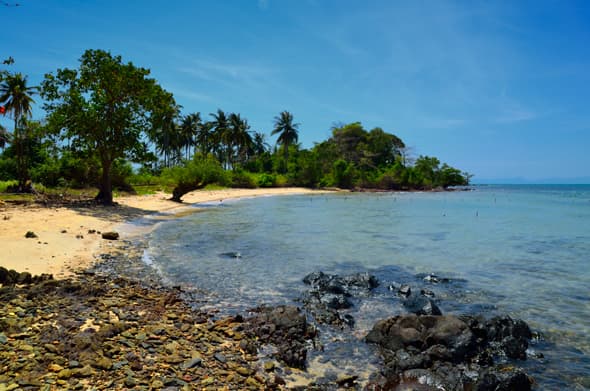
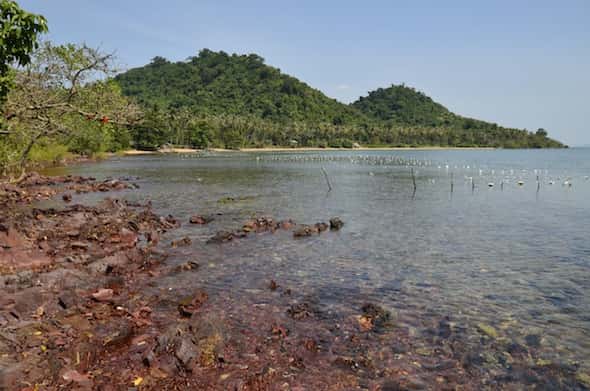
During our stay on Rabbit Island we had time to walk the coastline, enjoy the crystal-clear water and fine sandy beaches, get lost on the trails cutting through the island's jungle interior, and scramble up to the central hill's summit — from where you can see the islands dotted around Koh Thonsay.
One of Rabbit Island's beaches
Another beach on Rabbit Island
Flora lovers will find plenty to keep them entertained
Views from the island's summit
While we were getting a fire going one afternoon, a fisherman wandered over and offered us a couple of pieces of fruit. His English was non-existent but somehow we managed an exchange of smiles and gestures.
Not everything was idyllic, though. Our efforts to keep food sealed against the ants were undermined by the presence of field rats. On the second night we woke up to an enormous rat gnawing through the bags where we kept peanuts and vegetables, and from then on it came visiting every night despite our best efforts to keep everything out of reach.
And it wasn't just rats — during one of our jungle walks I came face to face with a several-metre-long snake, grey and orange, lying completely still about half a metre away. It shot off the moment a branch cracked under my feet.
One thing to bear in mind: there are a lot of mosquitoes, and more notably sand flies. After dark it's worth covering up and taking precautions if you don't want to spend the night scratching — but that's a problem all along the Cambodian coast. See how to avoid mosquito bites for what actually works.
Playing with dogs on Koh Tonsay
Sunset over Rabbit Island
Rats, snakes and insect life notwithstanding, we genuinely loved our days on Rabbit Island — a proper paradise that nobody visiting Cambodia should miss, and one of the very few islands in the country with a tourist offering that actually works for budget travellers. For the full picture of what Cambodia cost us, see the Cambodia budget breakdown.