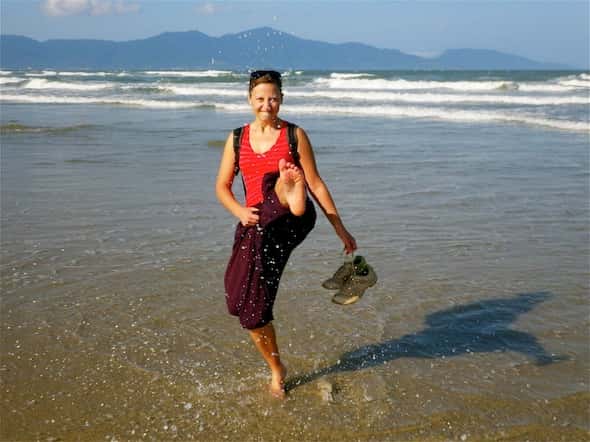
China Beach is a massive stretch of sand — 30 kilometres of it. This enormous yellow ribbon separates Da Nang, one of Vietnam's most populous cities, from Hoi An, the toy town.
During the Vietnam War, China Beach served as an R&R and rehabilitation centre for American troops, and it later lent its name to films and TV. Despite all that exposure, the coast has held onto its appeal. Only a handful of luxury resorts and hotels are scattered along its length, so it stays calm and quiet.
Why we walked it instead of taking the bus
We'd heard that roughly halfway between Hoi An and Da Nang there was a cracking little guesthouse — welcoming, cheap, with an all-you-can-eat buffet for about a euro fifty. Too good to pass up. And since it was under 20 kilometres, we decided to walk it with our backpacks.
It wasn't really about saving the bus fare — which would have been a couple of euros at most between us — it was about doing something different and walking along the sea.
Walking China Beach
The walk stirred up feelings a lot like the ones we get hitchhiking. We felt independent, capable and free again — something we'd been missing after days of buses and trains, moving through the country without really touching it or its people.
Mr Troy and Vietnamese hospitality
After the first 4 kilometres we reached the coastal road, a wide avenue with houses on one side and the sea on the other. That's where Mr Troy caught our attention — a friendly Vietnamese man bellowing at us at the top of his voice and practically dragging us by the arm towards his house.
Mr Troy was convinced we must be hungry, walking in the sun like that, and flung his door wide open. He offered us various typical Vietnamese foods, some of them specific to this time of year — during Tet, the Chinese New Year — including sweet rice rolls, sweets, dried fruit in a sweet-and-sour sauce, Vietnamese tea and rice whiskey.
Mr Troy opened the doors of his home and his fridge to us
A small part of what we enjoyed with Mr Troy
He told us about his plans to extend his house, warning us that if we passed by the following year we wouldn't recognise it. He explained he was building it himself, having saved up enough to cover all the costs — an estimated $5,000. Less than €4,000 to build a house.
That reminded us of Mr Po, the owner of the guesthouse where we'd stayed in Tat Lo (Laos), who'd told us he'd built his own place for around €5,000 at the time.
Refreshed and grinning, we carried on towards the promised guesthouse. Along the way several more families waved us in — we had to start turning offers down or we'd never have made it before dark.
Every time we set our bags down for a rest, someone would appear and insist we come in. Vietnamese hospitality floored us. It's the same warmth that carried us all the way down the Vietnamese coast in the weeks that followed.
We finally made it!
The beach, the crabs and a closed buffet
Sadly the day didn't end quite as well as it began — we arrived to find the guesthouse shut, so the all-you-can-eat buffet was off. We found a room in a neighbouring place for the next few days, though, and made the most of China Beach itself.
Enjoying sun and beach in February
China Beach had no shortage of crabs
The Marble Mountains — for free, at closing time
We also went to discover the Marble Mountains — a cluster of hills riddled with caves and temples that also feed marble and stone to the sculptors and stonecutters clustered around their base.
The best time to visit, in my experience, is around sunset. When we went, the ticket booths closed around 5:30 pm but the gates stayed open. You get the last hour of light, a much quieter wander, and — that day at least — you don't pay a thing. It's the same trick we lean on everywhere: see the 12 places I've slept for free for more of that budget-traveller instinct.
The village at the foot of the Marble Mountain
Views from the Marble Mountains
The great Buddha of the Marble Mountains
All our memories of these days are good — the walk, the beach, the mountains — though it was a shame the Hoa guesthouse was closed for Tet, since the food stalls nearby left a lot to be desired.
Even so, if you're passing through Hoi An: get out here. It's worth it.
Frequently asked questions
How far is it from Hoi An to Da Nang along China Beach?
The full beach runs about 30 kilometres between the two cities. We walked just under 20 km of it, from roughly halfway up to Da Nang, carrying our backpacks. It's flat and easy — the only real enemy is the midday sun, so start early and carry water.
Can you walk from Hoi An to Da Nang?
Yes. The coastal road and the beach itself make it a perfectly walkable stretch, and it's a far more memorable way to cover the distance than the bus. Break it over a day, expect to be invited in for tea more than once, and you've got one of the nicest cheap days out in central Vietnam.
When is the best time to visit the Marble Mountains?
Late afternoon, towards sunset. When we went, the ticket booths shut around 5:30 pm but the gates stayed open, so you catch the last of the light, the crowds have thinned, and you may not pay an entrance fee at all. Hours and ticketing can change, so treat this as a tactic to try rather than a guarantee.
What is Tet and how does it affect travel?
Tet is the Vietnamese (Lunar) New Year — the country's biggest holiday. Families gather, doors open to guests, and the hospitality goes into overdrive, as we found with Mr Troy. The flip side is that many guesthouses, restaurants and shops close for several days, so plan around it. Here's more on Hue and Tet during the Year of the Dragon.