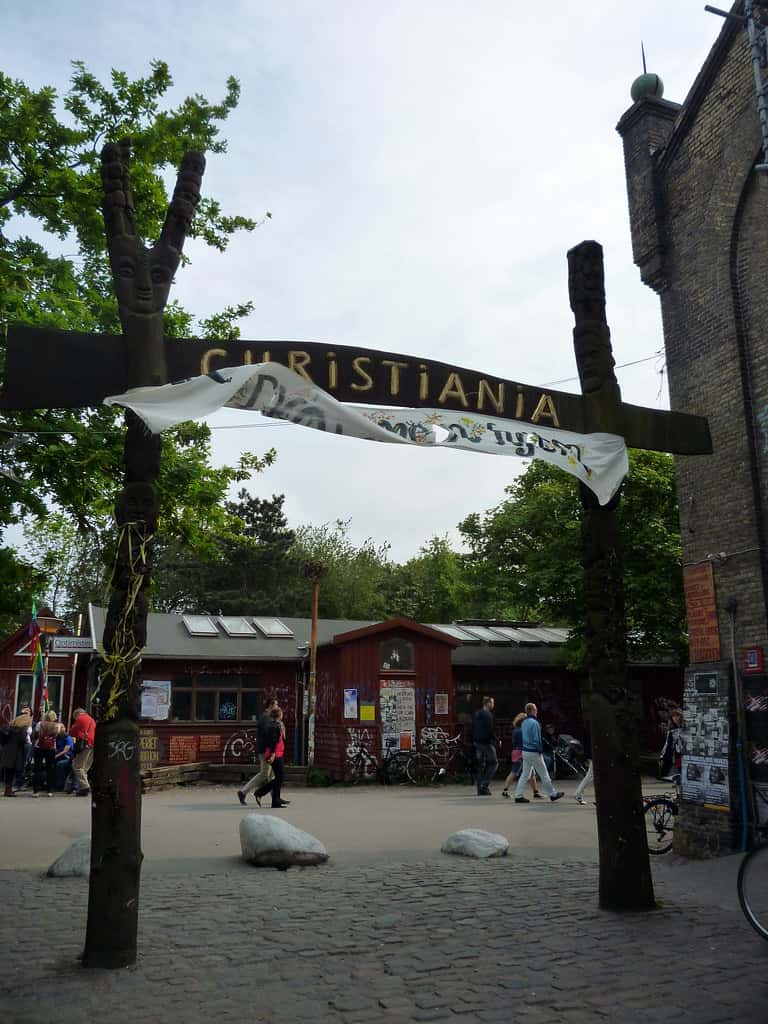
Right in the centre of Copenhagen sits Christiania, a self-governing neighbourhood run by its own residents, operating under its own rules and its own economic system. Locals call it Freetown Christiania (Fristaden Christiania), and once you walk through the gates it genuinely feels like stepping out of Denmark and into a country of its own.
How Christiania came to exist
This unusual settlement is found in the Christianshavn district and covers about 34 hectares. Originally a military compound, it was abandoned by the Danish army in 1971.
On 4 September of that same year, a group of parents decided to tear down the fence so their children could play there — it was a safe, enclosed space to keep the kids occupied.
In the seventies, housing prices in the Danish capital were sky-high, so people began moving onto the land — initially in a disorganised way, partly as a form of protest against the government.
Christiania quickly evolved into a community where the hippie, squatter, anarchist, anti-capitalist and collective movements flourished. Its members aspired to build a genuinely self-governing, self-sufficient society in which everyone looked out for each other and for the community as a whole.
A free town with its own rules
They declared themselves openly against hard drugs but in favour of soft drug use — something the Danish government tolerated, though since 2004 efforts have been made to control and restrict it again.
One of the notable rules of this community is the right of use, considered more important than the right of ownership — meaning that if you abandon your home for more than six months, you could lose it.
When any matter of general interest needs to be discussed, Christiania's roughly 900 inhabitants gather to debate and vote on decisions together. There are no political leaders and no police; decisions are taken by consensus at community meetings. The same goes for anyone who wants to join: they must be approved by a popular vote.
Christiania's economy is based on tourism, hospitality and the soft drug trade. It has become one of Copenhagen's main tourist attractions, and its residents are exempt from taxes — which helps sustain the community's self-sufficiency, no small thing given Denmark's notoriously high tax rates.
There's a strong recycling and green culture throughout the settlement — you'll find bins dotted all over the place, along with plenty of signs asking visitors to use them. Private vehicles are banned, and the only form of transport inside the enclosure is the bicycle. Fittingly, Christiania is also where the famous Christiania three-wheeled cargo bike was invented — you'll spot them all over Copenhagen carrying kids, dogs and shopping.
Visiting Christiania: a few things to know
Christiania is free to enter and open to anyone — you just walk in. But it isn't a theme park, it's people's homes, so a bit of respect goes a long way:
- Don't take photos on Pusher Street, the lane where soft drugs are openly sold. Signs make it very clear, and the dealers take it seriously. Elsewhere in Christiania, photographing the colourful houses and murals is generally fine.
- The drug trade is still illegal under Danish law, however tolerated it looks inside. Buying is at your own risk, and there are periodic police clear-outs.
- Bring cash. Many of the little cafés, bars and craft stalls don't take cards.
- It makes an easy, free half-day out — pair it with a wander around photogenic Christianshavn and its canals next door. If you're doing Copenhagen on the cheap, see my wider notes on travelling cheap and sleeping for free on the road.
Some photos of Christiania's urban area:
It's genuinely remarkable to find, right in the middle of one of the Western world's great capitalist cities, an anti-establishment, self-governing community like Christiania.
Frequently asked questions
Is Christiania safe to visit?
Yes. The community attracts hundreds of thousands of visitors a year and is one of Copenhagen's busiest sights. The usual common sense applies, and the one hard rule to respect is no photos on Pusher Street.
Can you take photos in Christiania?
Almost everywhere, yes — the murals, gardens and self-built houses are wonderfully photogenic. The exception is Pusher Street, where photography is strictly forbidden and signs make that very clear.
Is it legal?
Christiania exists in a long-running legal grey area. It's an officially recognised self-governing community, but the open soft-drug trade on Pusher Street remains illegal under Danish national law and is periodically targeted by police. Visiting and walking around is completely legal.
How much does it cost to visit?
Nothing. Entry is free and it's open to the public. You only spend if you buy food, a drink or something from the craft stalls — so bring a bit of cash.
How do I get there?
Christiania is in the Christianshavn district, a short walk from the Christianshavn metro station and easily reached on foot or by bike from central Copenhagen. Like the rest of the city, it's best explored on two wheels.