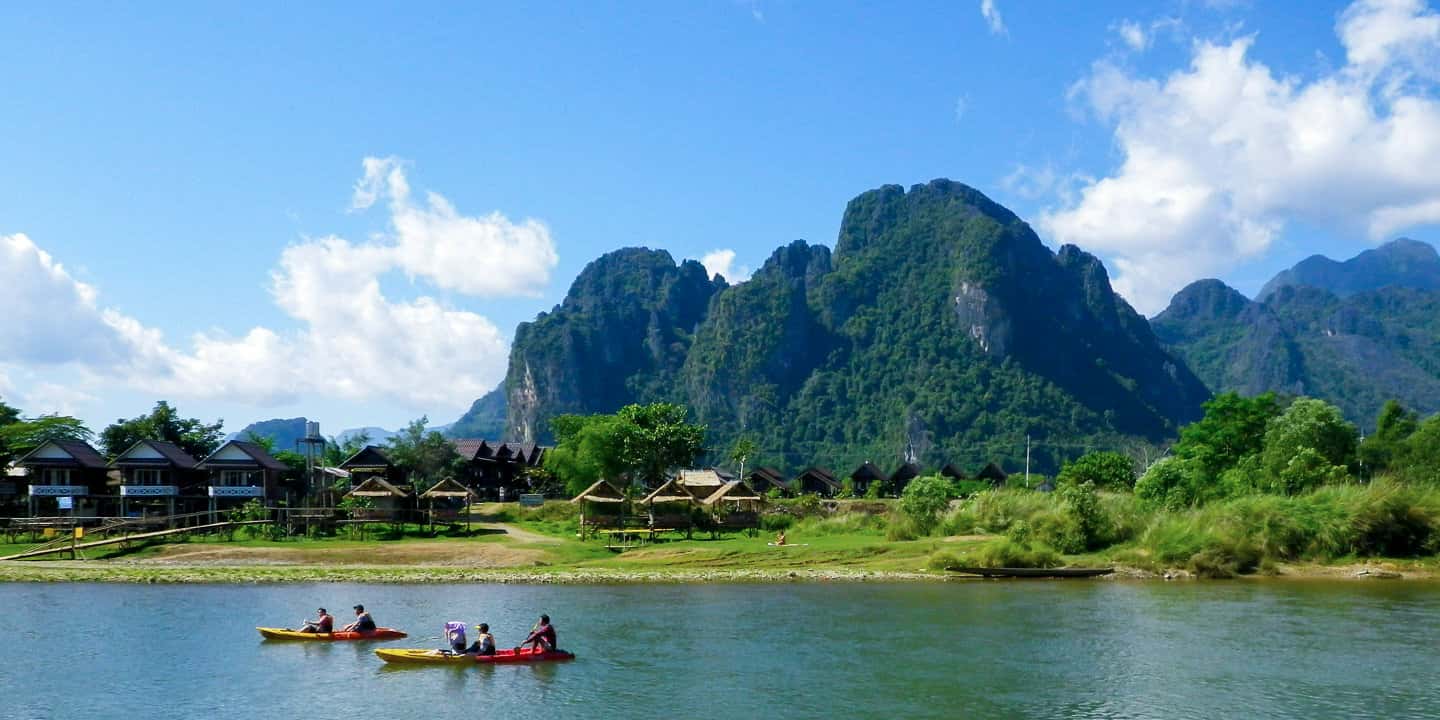
Vang Vieng is a town in northern Laos, roughly halfway between Vientiane and Luang Prabang. Not so long ago it was barely a bus stop, before the backpacker tide hit Laos and turned a gorgeous landscape into a tourist attraction.
The surroundings are paradise: beautiful mountains, inviting lakes, and interesting caves with natural pools. The catch is that access to every single cave costs 10,000 kip; you even have to pay to cross the river on one of the bridges — though you can easily dodge this by using the pedestrian bridge.
Reminder: 1 euro equals roughly 10,400 kip, so entry to each cave works out to around a euro.
Tourist buses roll in from every corner of Laos, but you can easily get here on local buses instead. The public bus from Vientiane costs 40,000 kip and takes about five hours.
We stepped off the bus by the road, next to a large open area, beyond which stretches most of the town's accommodation, restaurants, bars, stalls, markets, shops, travel agencies, and everything else aimed squarely at foreigners.
The free bridge crossing the river in Vang Vieng
There is nothing authentic here. If you come to Vang Vieng expecting to discover Laos, you won't — all you'll see are businesses oriented entirely and exclusively towards pleasing tourists.
Vang Vieng is famous for tubing: renting a giant rubber ring (think lorry tyre), getting a tuk-tuk a few kilometres upstream, and drifting back to town on the river current. You can also do kayaking, with the option to paddle all the way down to Vientiane for around 200,000 kip.
In the mornings we made the most of it — walking in the mountains, exploring caves, soaking up the views.
Walking near Vang Vieng
These days Vang Vieng has become the party hub in Laos for backpackers looking to drink and hook up. Tubing is generally done drunk, and the spectacular scenery is ignored by the majority, who spend the morning recovering from the night before.
One place that remains unchanged — aside from the thumping music you can hear from the distant riverside bars — is the organic mulberry farm. At the Organic Farm restaurant you can try exquisite mulberry shakes, mulberry wine, and crêpes and cakes made with the fruit. But it's not just mulberries: the menu also features excellent Lao dishes and a fluffy goat's cheese.
Road sign for the organic farm
Goat's cheese at the organic farm
Tofu laab, a traditional Lao dish with heavily spiced raw meat
Mulberry and honey tart from the farm
The farm is further from the tourist area than the guidebooks suggest — around 6 kilometres, not 2 or 3 — though you can walk it. If you want to try the mulberry shakes or wine without making the trip, there's also an Organic Farm café in the tourist zone.
Loads of sandwich and crêpe stalls line the streets of Vang Vieng, especially at night. A decent chicken, tuna or bacon baguette costs 10,000 kip, with 5,000 kip per extra ingredient.
One of the many sandwich, burger and crêpe stalls
We stayed at a guesthouse called Bounpheng, where we got an excellent clean room with a huge comfortable bed, en suite bathroom with hot water, internet access and unlimited drinking water. The room cost just 40,000 kip per night.
From Vang Vieng we headed back to Vientiane, to cross into Vietnam via the Nam Phao border crossing.
On the morning we left Vang Vieng, someone was enjoying the sunrise by hot air balloon