Vientiane — the capital of Laos, not Vietnam. For anyone who hasn't spent time looking at Southeast Asian destinations or maps, Vientiane and Vietnam can sound confusingly similar.
The Lao capital sits on the northern edge of the country's central zone, spread along the banks of the Mekong — like almost every major city in Laos — looking directly across at Thailand. A neighbouring country you can reach simply by crossing a bridge, passport in hand.
Because of its location, Vientiane is the transport hub of Laos. Every traveller going north to centre, or south (or centre) to north, has to stop here and change buses.
The calm that defines the whole country is slightly disrupted in the capital, as in any big city — but there's still enough of it to make Vientiane one of the most relaxed capitals I've been in. I could almost compare its main avenues to Vienna's, vast differences in development between Austria and Laos aside.
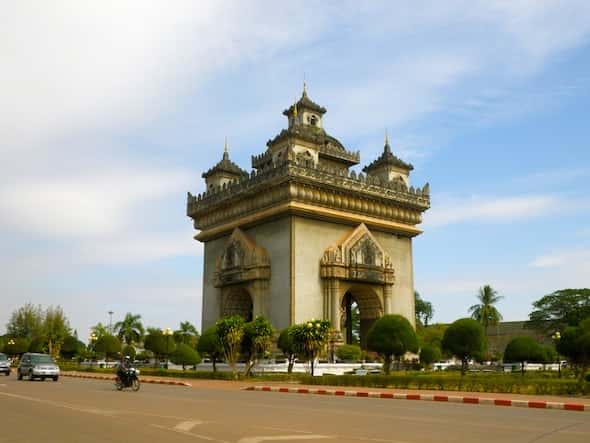
One of Vientiane's monuments with an unpronounceable name
We arrived in Vientiane very late — gone 10pm. The search for cheap accommodation was mildly alarming: every guesthouse had a full sign up, or the prices were sky-high.
Eventually we found a guesthouse that looked awful from the outside but had a spacious, clean, comfortable double room for 60,000 kip — which was the floor price in this city.
Quick reminder: 1 euro = 10,400 kip, so 60,000 kip is about €6.
The next morning we checked out having found somewhere slightly better (with Wi-Fi and an en-suite bathroom) for the same price — though the internet turned out to be so slow it would have been better not to have it at all.
Statue in a temple
The capital has a solid range of nightlife and cultural sights — but none of it particularly called to us. We only had two goals: move on north, and get a two-month tourist visa from the Thai embassy.
Our plan at that point was to go to Vietnam after Laos, and then Cambodia, which would mean coming back through Thailand overland. Since we didn't want a repeat of the visa-on-arrival situation for Latvians like Ilze, and we wanted to spend more time discovering Thailand, a two-month visa seemed the obvious answer.
On our first morning we headed to the Thai embassy — but because of the hostel change, we didn't arrive until past 1pm. Unlike most embassies we'd dealt with, the Thai embassy stops processing visas at midday, which meant two more days in the capital: one to submit, one to collect the passport.
During those days we barely did any sightseeing — Vientiane didn't grab us and we preferred to rest and write after the beatings we'd taken on the loop.
Emperor's statue
The bus network is organised around three terminals: one in the south for all southbound traffic, one in the centre near the morning market for nearby northern destinations and city transport, and one in the north for cities beyond Vang Vieng.
If you need a tuk-tuk or songthaew between the southern and central terminals, they'll quote you around 20,000 kip per person — but 10,000 is perfectly achievable. To go even cheaper, look for the city buses: 3,000 kip between terminals, plus 2,000 kip per bag you put in the luggage compartment.
Once our paperwork was sorted and we'd recovered some energy, we took the local bus to Vang Vieng for 40,000 kip.