Our plan was clear: we wanted to walk across the Vietnamese border and keep walking, no rush, all the way to Kep — the first town on the Cambodian coast.
The Cambodian border is just 7 kilometres from Ha Tien, and Kep is about 20 kilometres past that, so the walk would be tough in the heat but entirely doable.
We were convinced that some wonderful encounter was waiting for us along the road, as had happened when we walked from Hoi An to the Marble Mountains along the China Beach.
When the weather has other plans
Unfortunately, the day before our visa expired, it rained non-stop. It was still pouring through the small hours of our departure morning, making our walking plan feel considerably riskier — especially without a proper tent, just the mosquito tent we'd used at Ko Samet for shelter if we couldn't make it to Kep.
This is the quiet tyranny of a land border: your visa decides the day, not the weather. We couldn't simply wait it out for a dry morning, because the moment our Vietnamese visa lapsed we'd be overstaying — and you do not want to be arguing about that with an official at a remote crossing. So the romantic plan gave way to the sensible one.
In the end, reluctantly, I bought a couple of tickets with a new company running transfers from Ha Tien to Kep. After a fair bit of haggling, the cost came to 150,000 dong per person.
1 euro is currently around 27,000 dong, so 150,000 dong works out at about €5.40.
The crossing itself, step by step
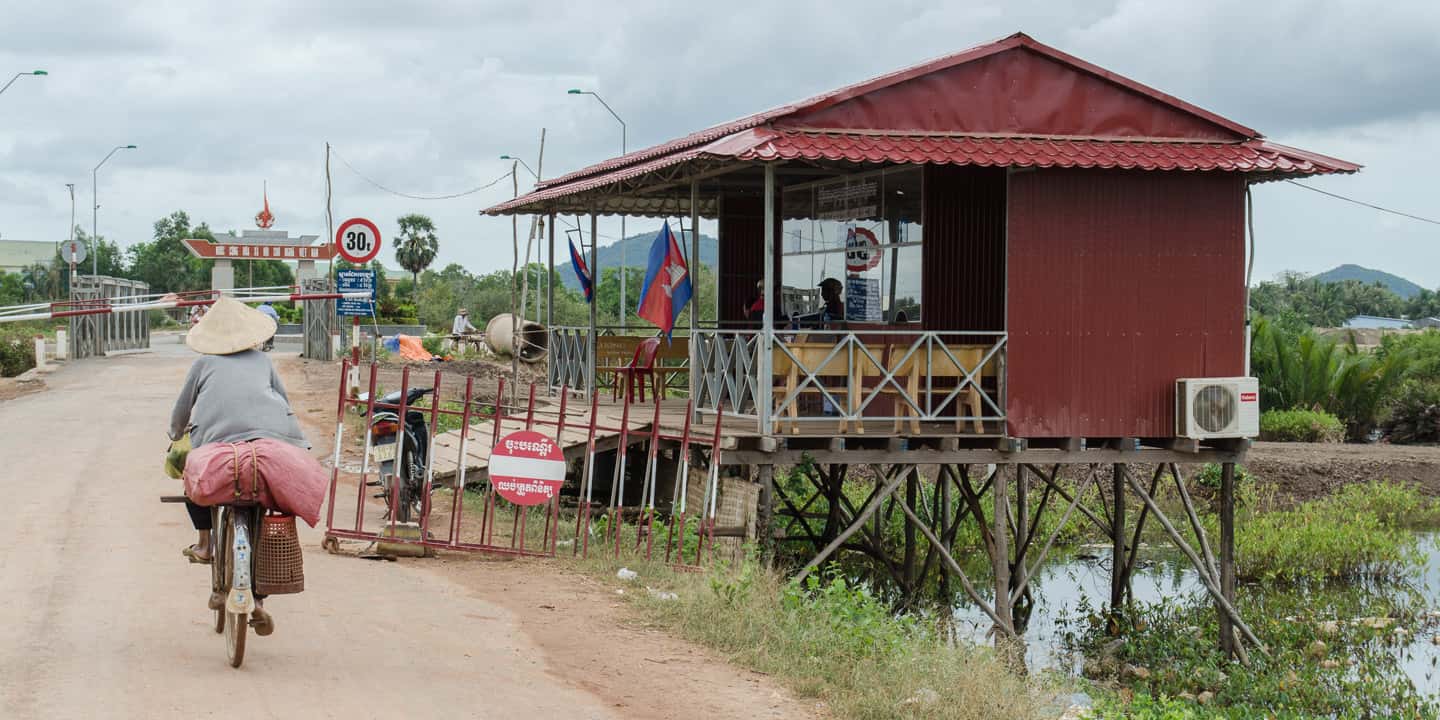
The Vietnamese side of the border went without a hitch, and we reached the Cambodian checkpoint without incident.
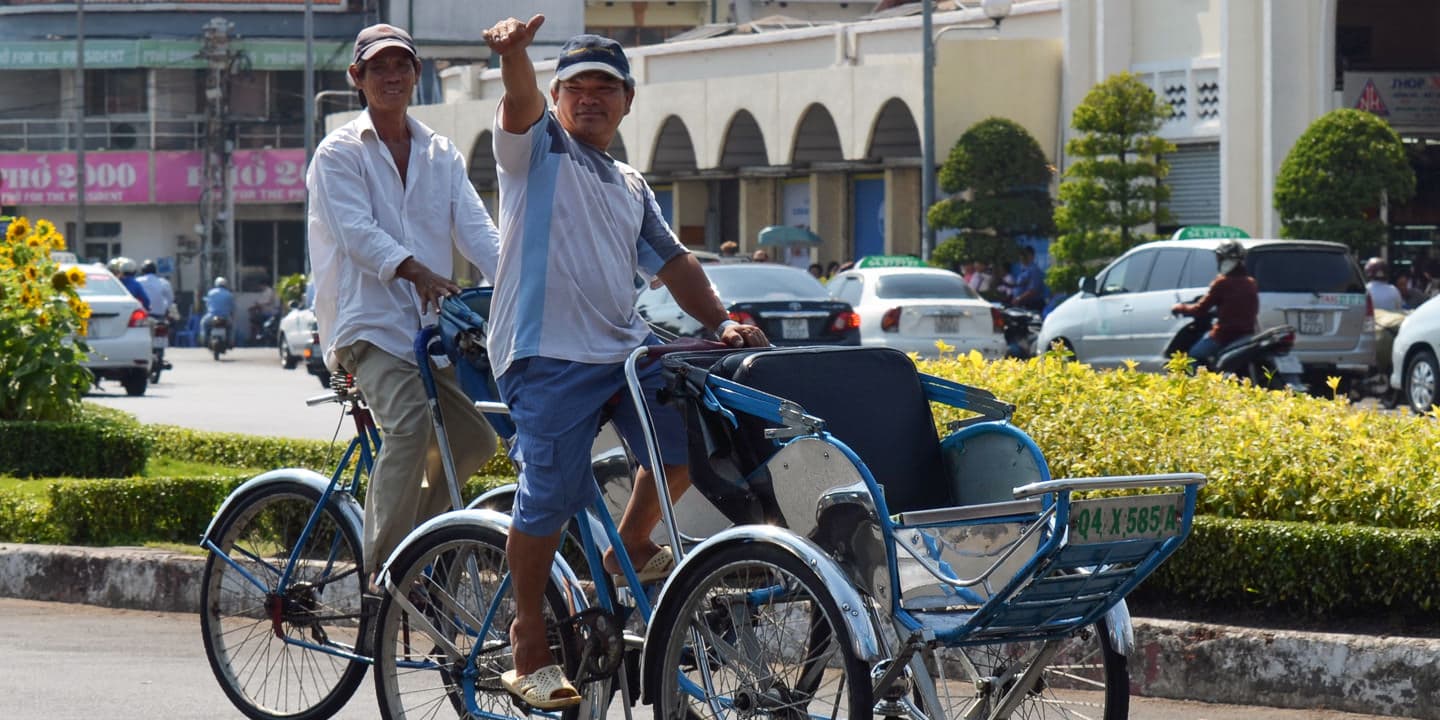
Locals cross the border on more traditional transport
Since we'd got our visas sorted in Bangkok, we didn't need to pay or fill out paperwork there — just the entry form. Everyone who hadn't sorted their visa in advance paid the 25 USD without complaint, though it's worth knowing you can pay just 20 USD if you push a bit — that's the actual cost of the tourist visa.
That gap between what they ask for and what the visa actually costs is the whole game at land borders: a small "convenience" surcharge that almost everyone pays simply because they don't know any better, or don't fancy a fuss while tired and sweaty in a queue. Knowing the real figure before you arrive is half the battle. (Fees and on-arrival rules shift over the years, so treat any specific number you read online as a starting point to verify, not gospel.)
The casino strip in no man's land
Past the border into Cambodia, we found an enormous casino complex — six gambling buildings in the immediate border zone.
Ilze eyeing up the casino
Another small border casino
The "medical questionnaire" shakedown
It looked like everything was going smoothly — until a few metres further on they made us get off the minibus again, this time to fill in a medical questionnaire and pay 1 dollar for the "information and assistance" they were offering.
Everyone else filed through and paid, until it got to our turn. I waited until we had our passports back — important in situations like this — before making it clear I wasn't paying a dollar for a non-existent service.
The Cambodian official insisted that the form guaranteed us medical cover in Cambodia and that we had to pay to be covered in the country. I was quite sure there was no obligation to pay, but his explanation actually made it even easier to wriggle out of it: all I had to do was say I had health insurance.
I don't have any insurance — Ilze does — but neither of us had a card with us. So I handed him the first piece of paper I found next to my passport: my vaccination certificate.
He glanced at it and, with a sour look, told us it was fine — then turned his attention back to squeezing the last few passengers through the queue.
The "dollar for medical cover" was, of course, nonsense. A vaccination card is not health insurance and proves nothing of the sort — but the official had built his own trap by claiming the fee bought you cover, which meant the moment I claimed to already have cover, his story had nowhere left to go. That's usually how these little fees fall apart: you don't have to win an argument about whether it's legitimate, you just have to calmly remove the reason they invented for it.
From there, the journey to Kep went without incident — pleasant scenery and barely a drizzle, which made me regret not having walked the whole way from Ha Tien.
What I'd tell anyone crossing here
A few things this crossing taught me, all of which travel well to other land borders in the region:
- Get your passport back before you dig your heels in. I waited until both passports were in our hands before refusing the dollar. Never start a standoff while an official is still holding your document — you've handed them all the leverage.
- Know the real visa price in advance. The gap between the quoted figure and the genuine cost is where the small surcharges live.
- Stay polite, patient and faintly cheerful. Nobody likes being called a liar, even when they're trying it on. A friendly, unbothered "no thanks" works far better than indignation, and you still have to ride away on their minibus.
- Have a documents folder. Insurance details, vaccination card, visa printouts and passport photos all in one place. Half the time the magic isn't having the right paper — it's being able to produce a convincing one without rummaging.
- Let the visa clock, not the weather, set your departure. We learned this the soggy way. Build in a buffer day so a downpour doesn't force a last-minute scramble.
If border games make you twitchy, I've gathered the wider lessons in how to avoid getting scammed at a land border crossing. And on the question of whether to bother with insurance at all, here's my take on travel insurance.
Once you're through, Kep itself is a gentle place to land — read more in Kep: Cambodia's crab resort and say welcome to Cambodia.
Frequently asked questions
How far is it from Ha Tien to the Cambodian border, and on to Kep?
The Cambodian border (the Prek Chak / Xa Xia crossing) sits about 7 kilometres from Ha Tien, and Kep is roughly another 20 kilometres beyond that — call it 27 km of road in total. Flat and entirely walkable in good weather, but brutal under tropical sun or, in our case, monsoon rain, which is why we caved and took the minibus.
Can you walk across the Ha Tien–Kep border?
You can certainly walk the roads on either side, and that was our original plan. What stopped us wasn't the rules but the relentless rain and a ticking visa, with only a flimsy mosquito tent for shelter if we got stranded. In dry weather, walking out of Ha Tien towards the border is a lovely, doable idea.
Do I need to arrange a Cambodia visa before this crossing?
We'd sorted ours ahead of time in Bangkok, so we only filled in the entry form. Travellers without one paid on the spot. The real cost of the tourist visa was less than what was being quoted at the window — but exact fees and whether visa-on-arrival is offered here change over time, so confirm the current rules close to your trip rather than relying on this post.
Is the "$1 medical questionnaire" at the Cambodian border a scam?
In our experience, yes — it's an unofficial fee dressed up as health cover, and a vaccination card is not insurance. We declined politely once our passports were safely back in hand, said we already had cover, and were waved through. Plenty of border "fees" in the region work this way; staying calm and unbothered usually does the trick.
Why are there casinos right on the Cambodia border?
Gambling is heavily restricted across the border in Vietnam, so casinos cluster on the Cambodian side to pull in players from across the line. It's why a sleepy rural crossing like this one is fronted by a surprisingly large strip of gambling halls in what is otherwise the middle of nowhere.
Crossed at Ha Tien yourself, or run into one of these "fees" somewhere else? Tell me how it went in the comments.