We pedalled the last dozen or so kilometres from our campsite to the border between Croatia and Montenegro.
A formality for me, but a constant gripe for the locals — who still can't quite get their heads around having to check in just to cross into what, until recently, was the neighbouring region.
The Croatian border post was the most relaxed I've ever encountered. One officer beside a small booth, and he couldn't be bothered to check our papers. He was deep in a phone call, so without so much as taking our passports out of the bag he waved us through. Goodbye, Croatia!
The Montenegrin border
A few hundred metres further on sat the Montenegrin border post.
As throughout the Balkans, I used my Spanish national ID card to avoid filling passport pages. Others collect the stamps — I prefer to save mine for Asia, delaying the moment when I'll have to renew my passport from the other side of the world.
I haven't found much information on what that renewal process actually involves, but it doesn't seem to be a quick fix — more likely an indefinite hold while embassies and administrations sort themselves out.
Ilze, on the other hand, didn't have a Latvian ID card — they didn't exist until about a year ago — so she's been using her passport throughout.
Please don't stamp me in the middle of a blank page. Use one that already has stamps on it… I need the blank pages for Asian visas.
She says the same thing at every border, with mixed results. This time they half-listened: they put the stamp on a page that already had one, but planted it square in the middle of the page. She wasn't impressed.
First time in Montenegro
We were about to roll, for the first time, on Montenegrin soil — neither of us had ever been to this corner of the Balkans.
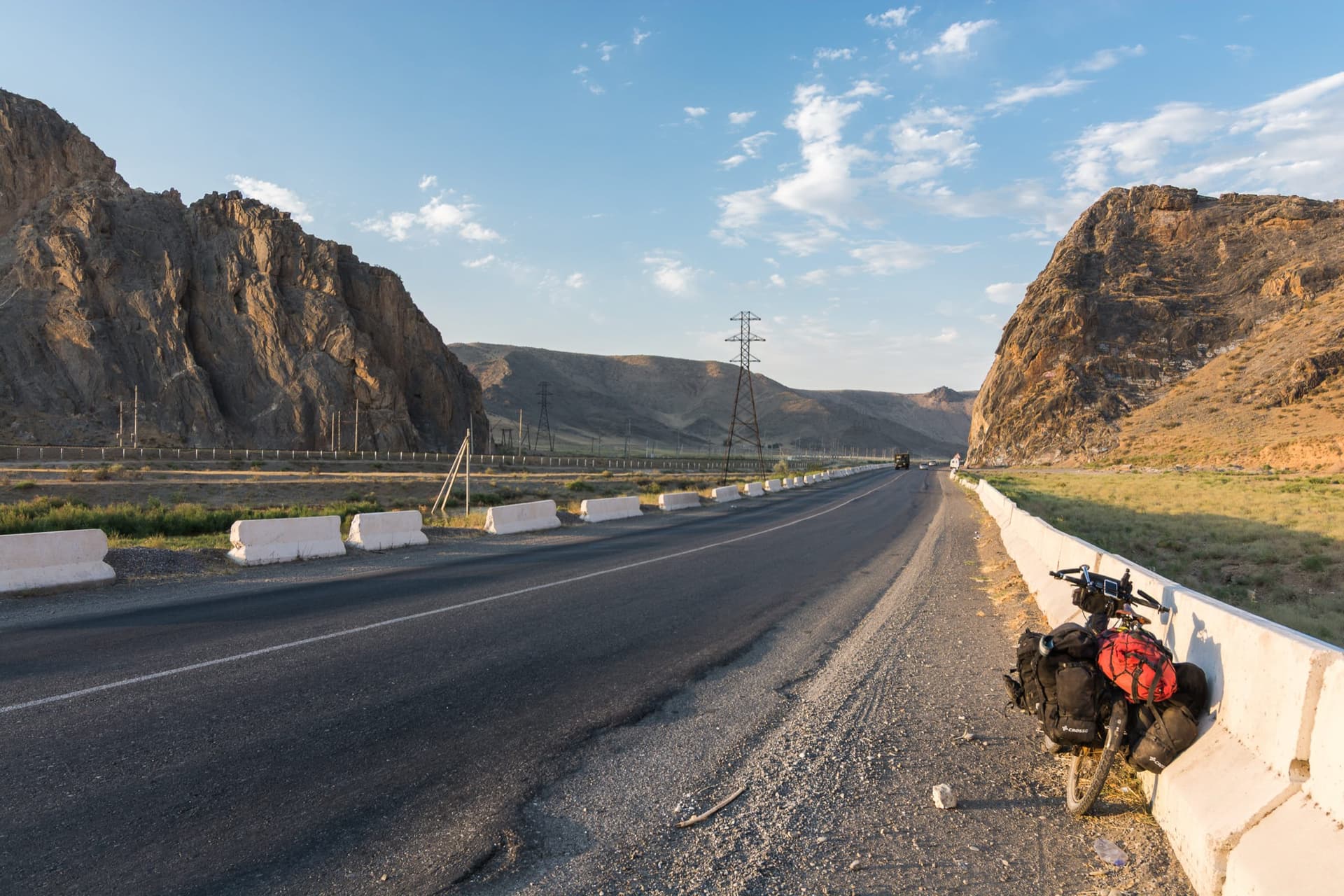
Entering Montenegro along the coast gave us a chance to remember what riding on the flat feels like. We'd spent several weeks on rollercoaster roads, constant up-and-down, so a stretch alongside the sea was very welcome.
There we reunited with Ishbel, the Scottish girl cycling solo who we'd been riding with for the past two weeks in Mostar and through Bosnia and Croatia. And with a couple of Canadian girls we'd met the night before at the Warmshowers member's free campsite — the one run by the man who greeted guests in his underpants.
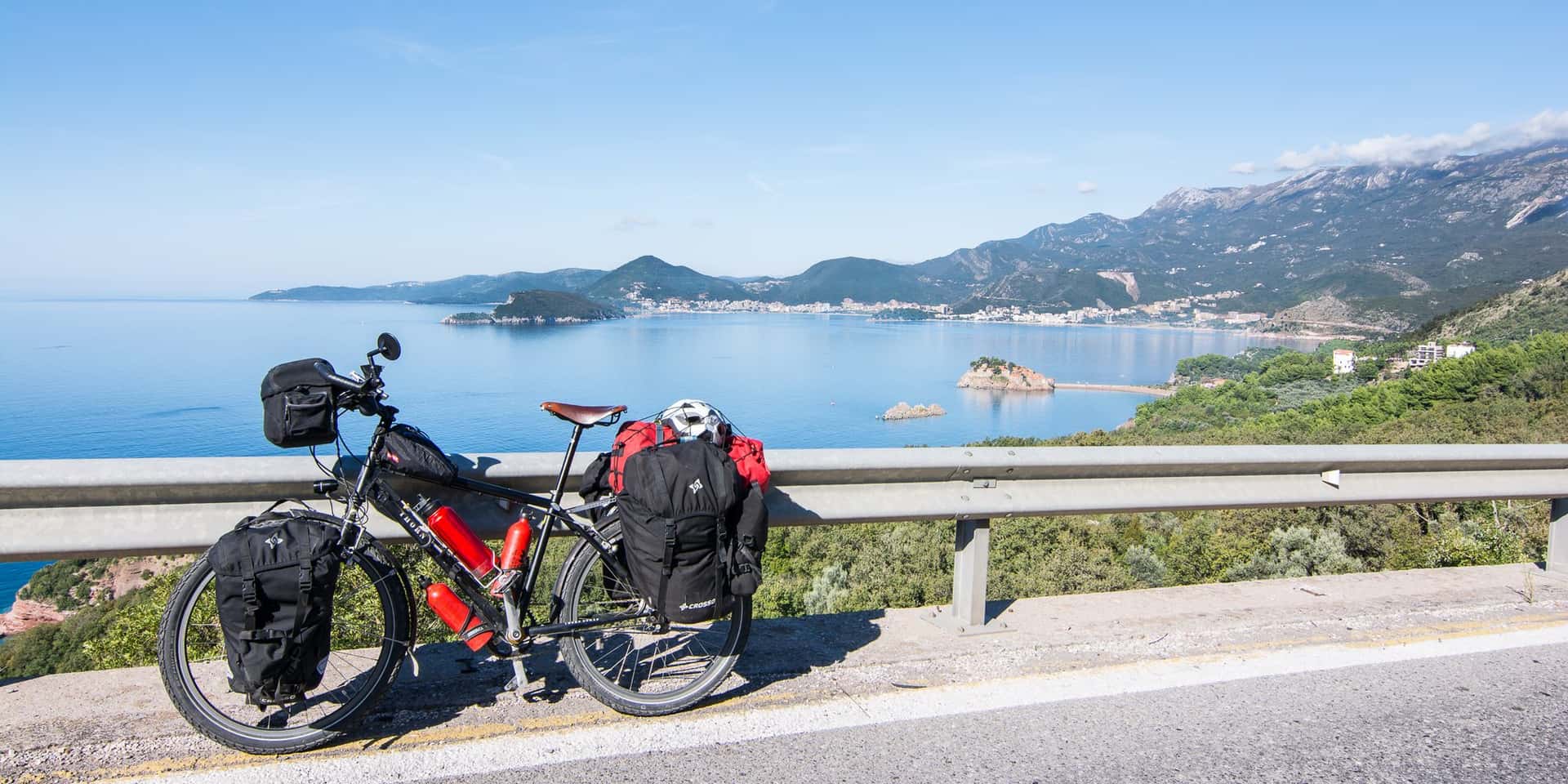
We all followed the famous Bay of Kotor together — a bay within a bay, like a peninsula made of water.
The road hugging that coastline runs about 40 kilometres, and there we camped with three tents beside one of the beaches. One of the perks of arriving in Montenegro in the off-season.
Our spot was perfect — metres from the water, with trees to give the tents a bit of cover and a bar nearby with decent Wi-Fi that reached as far as one end of the beach.
What more could you want from a night's sleep? Why would you ever pay for a campsite?
The Montenegrin coast by bike
After rounding the Bay of Kotor we continued south along the coast towards Ulcinj, where we had a Couchsurfing host lined up.
En route we spent a night in the grounds of a small religious building, tucked in beside a little chapel. We even had a water tap and a view of the beach from up on the hill.
The next morning we were back on the Montenegro coast's relentless up-and-down. A hundred metres of climbing, 130 of descent, 180 up, 90 down, 50 up, 120 down, and again…
At one point we stopped to rest in the shade of a building and used an open Wi-Fi from one of the nearby houses to check email and let our Couchsurfing host know we were on the way.
One of the neighbours arrived by car with his daughter and spotted us with the bikes. He parked up, came over, asked where we were from, where we were going, how long we'd been on the road. A few minutes later he was back with a bag containing a couple of kilos of mandarins. Thank you!
Couchsurfing in Montenegro
We finally arrived in Ulcinj — only to find that we weren't actually staying at our host's house, but at his hostel. That set off alarm bells. Is this really Couchsurfing? Is he planning to charge us?
We locked up the bikes and had a chat with our host. He said nothing about payment, which reassured us. We'd already agreed between ourselves: if he mentioned money, we'd pick up our things and camp on the edge of town; and if he tried to surprise us with a bill in the morning, he'd be very disappointed.
As the evening wore on, our guard came down. His English wasn't great but we understood each other well enough, and it turned out his idea behind using Couchsurfing was to practise his English for his newly-opened hostel.
A heavy storm rolled in and pinned us there for a couple of days, during which I helped him with a few things he'd been struggling with — like getting his business listed on Tripadvisor and Google Maps.
We also learned that the Ulcinj region is the poorest in Montenegro because its status is provisional — the population is majority Albanian, and the central government won't invest there given that it could eventually end up in Albanian hands.
A Montenegrin farewell
The road south towards Lake Skadar and the Albanian border was lovely — and after a couple of short climbs, beautifully flat. An absolute pleasure to ride.
Halfway along I spotted a bakery and we stopped to grab something to eat. They had a kind of pizza-stuffed roll, roughly 40 cm long, for 20 euro cents. I was sold. We sat down at one of the tables.
That's when a Montenegrin man came over, asked us a couple of questions about our trip in excellent English, and then bought us a couple of yoghurts and an enormous burek.
We couldn't have asked for a better send-off. Thank you for everything, Montenegro!