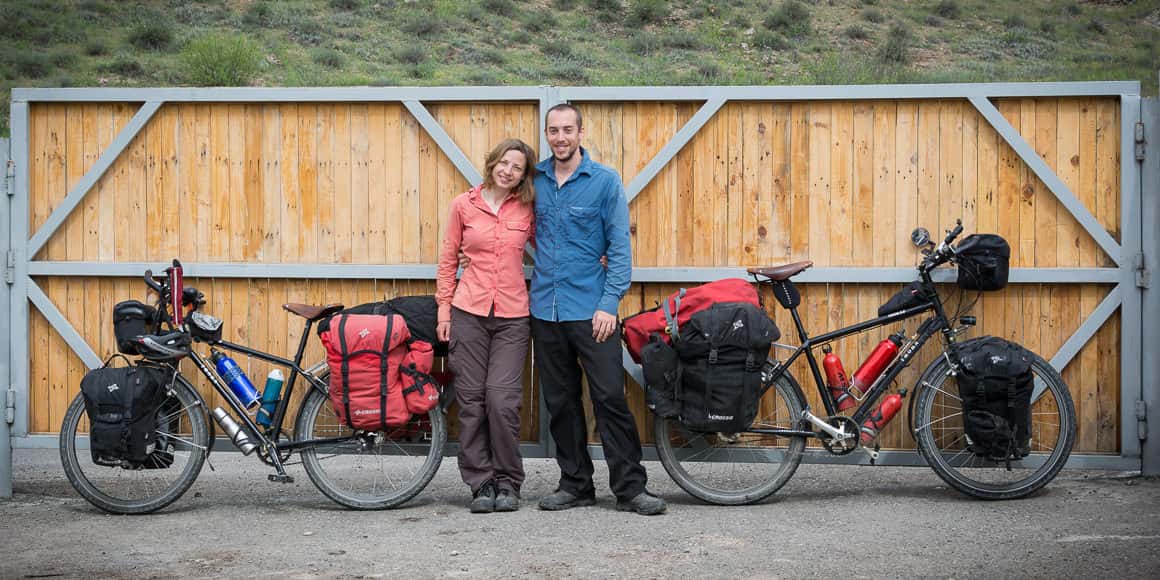
16,000 kilometres and eighteen months into our round-the-world cycle tour, we've built up a pretty clear picture of the calls we got right — and the ones we didn't — when choosing our travelling companions: the Thorn Nomad Mk2 touring bikes.
This article focuses on those bikes and Thorn's service, but it could equally be useful for anyone considering any touring bike. Maybe it'll help someone rethink a few decisions before they commit. We chose these bikes after a lot of agonising — you can read about the day we ordered our Thorn Nomads — so this is the long-term verdict on whether that agonising paid off.
The frame — steel or aluminium?
One of the things that swung me towards Thorn in the first place was their commitment to steel, but after eighteen months I'm less sure. The main advantage of steel is that it can be welded in an emergency — but after an accident where I bent the front fork, Thorn told me to replace it rather than try to straighten it, as attempting to bend it back would weaken it further and it could fail without warning at some point on the road.
So if something breaks, you end up replacing it anyway if you want to be safe — which rather reduces that steel advantage. Yes, you can patch it on the side of a road "just about anywhere" in an emergency, but if you're going to need a new frame in the end, you're better off hitchhiking to a city and buying one, skipping the bodge.
The other supposed advantage of steel is road vibration absorption, allegedly better than aluminium — a slight built-in suspension effect. But I honestly don't know how noticeable that is in practice. I'd need to ride an identically specced bike with an aluminium frame to find out.
The Rohloff internal hub
I was completely sold on having a hub that wouldn't give me trouble, with minimal maintenance and near-unlimited lifespan. But for the price, it doesn't run as smoothly as I'd like.
When you buy it they warn you upfront that it's normal for it to catch slightly when shifting through the middle gears, and that the noise and resistance should fade with use. In my case, 16,000 km later, it still hasn't fully resolved. I'd probably still choose a Rohloff hub for a trip as long as mine, and I've had no serious problems with it, but it's not perfect.
26-inch wheels?
We chose 26" wheels for availability in remote areas, but given the premium price of quality materials and our preference for tyres robust enough to resist punctures, we ended up carrying spares with us anyway (specifically Marathon Mondial tyres) — which largely cancels out the main advantage of 26" wheels and makes you wonder whether you'd have been better off with a larger diameter for added comfort over the rough surfaces we've ended up riding.
Even finding a tube can be an ordeal in certain countries. We were thrilled to have 26" wheels — the standard! — only to find that tubes in some countries only come with a different valve type that doesn't fit our rims.
29" wheels (700c) might well have been worth it, especially when it comes to unpaved roads in developing countries.
Flat bar with extensions
I stand by my preference for straight (or near-straight) bars, though I wouldn't mind trying a butterfly bar at some point.
What I do consider essential if you go with a flat mountain-bike bar is having long extensions that let you shift your hand position — not just out to the sides but also further forward (or back, depending on whether you opted for a more aggressive or upright position).
Riding position
When you get measured up for a Thorn they ask how you want to ride — relaxed and upright, or more aggressive and aerodynamic.
At the time I chose something in between, leaning towards upright — but if I could choose again I'd go slightly more sporty, as long as the handlebar extensions let me return to an upright position whenever I wanted to.
Rim brakes
I'd seriously consider disc brakes on a future bike. Thorn says they're not recommended and prone to problems, but I've met a lot of cycle tourers who say the opposite — they stop far more effectively, and if you carry a spare you can replace them on the road. I genuinely don't know who's right.
Bear in mind that if you go with a CSS rim (as Thorn recommends), you'll need specialist brake pads that only a couple of brands in the world make and that you can't find almost anywhere — meaning you have to carry spares for long trips (they do last well), which is practically the same burden as carrying a spare disc.
The eccentric bottom bracket
Different manufacturers use different systems to maintain chain tension with an integrated Rohloff hub. Thorn uses an eccentric bottom bracket that rotates the position of the BB axle, increasing or decreasing the distance between the wheel and the pedals to take up chain slack. The problem is that this eccentric BB is Thorn-specific and you can only buy it from them.
I had to wait two weeks for them to send a replacement when I stripped the internal thread. Treat yours carefully, clean it regularly, and don't leave it a whole year before rotating it — it'll be an absolute nightmare to move and you might damage it in the process. To remove it, loosen the bolts first and take the pedals off. To rotate it, loosening the bolts and turning it is enough — but make sure it's perfectly centred with the BB at the top before tightening. Never tighten the bolts with the "BB hole" at the bottom, where there's less metal between the bolts and the hole, or you'll strip the thread.
The Thorn rack
Fairly happy with it — very stable, though I'd recommend putting padding or insulation tape on it from day one wherever your panniers attach, to protect the paint.
That said, if you go with a Tubus rack you'll get similar quality and price with an exceptional warranty. They might actually be the better option.
The Schmidt SON dynamo hub
Paired with an E-Werk voltage converter, it only charges my phone at around 300–350 mAh, which doesn't really convince me. It might be a phone compatibility issue — I haven't tested it with other devices — but it charges very slowly. The hub also makes a strange noise and vibrates slightly at high speeds (on descents) or when the front light and E-Werk are running simultaneously.
Accessories
I'd always buy extra spokes. They cost almost nothing, they weigh nothing, and they guarantee you have the exact size for your wheels — which are supposedly going to last thousands of kilometres.
The extra bar for a front bag isn't something I'd recommend if you plan to mount a front light on the fork (the bolt on the front dropout) — if the bag is at all large it'll block the light. It's more practical to keep the bag up on the handlebars where you can reach it while riding.
A rear-view mirror is, for me, an essential accessory. Mine broke a few months ago and I miss it enormously — I feel completely naked without it. It broke after a lot of abuse and held up to everything before that, so I still recommend it: Mirrycle bar-end mirror.
Thorn after-sales service and conclusions
The service is acceptable — they respond to problems and give you instructions for fixing them as best they can — but you have to chase them and they sometimes take several days to reply by email. Ask for recommendations on spare parts and they'll usually send you links to their own online shop, with specific proprietary products available nowhere else, sometimes with "unofficial" names.
In the end you have to sort things out yourself unless you don't mind overpaying in their shop and waiting weeks for shipments that are often painfully slow. Other online retailers ship faster and at better rates.
Overall, I'm happy with the bikes, but I'm not entirely sure whether Thorn's rigidity on spec choices (steel, 26", rim brakes) and their sluggishness in answering emails is enough to make me choose them again. From what other tourers have told me, brands like Santos are more "customer-friendly" and go further to keep their clients happy.
It's a small thing, but what annoyed me most was this: after spending over £2,000 on a bike, when I asked for one of those reflective ankle velcro straps as I was heading off, they still charged me for it. A pound. A textbook example of poor customer care.
One more thing worth considering: the euro-to-pound exchange rate. With the euro where it is right now, German or Dutch manufacturers might be considerably better value. When I bought mine the two currencies were much closer to parity.
If you're just starting to think about a setup of your own, it might also be worth reading how we geared up for the round-the-world trip in the first place, and the broader case for why we tour long distance on a budget — because the right bike is only worth it if the whole trip is built to match.
Frequently asked questions
Is the Thorn Nomad a good touring bike?
Overall, yes — I'm happy with mine after 16,000 km and I've had no serious failures. It's solid, capable and built to be lived on. My reservations are less about the bike itself and more about Thorn's rigidity on spec choices (steel, 26-inch wheels, rim brakes) and their slow, chase-them-up customer service. Whether I'd buy from them again, I genuinely can't say with confidence.
Is the Rohloff hub worth it for a long tour?
For a trip as long as mine, I'd probably still choose one. The appeal is real: minimal maintenance and a near-unlimited lifespan, with no exposed derailleur to smash. The honest caveat is that for the price, mine never ran as smoothly as I'd hoped — it still catches slightly in the middle gears even now. No serious problems, but not the flawless experience the price tag implies.
Should I choose 26-inch or 29-inch (700c) wheels for world touring?
We picked 26 inch for the classic reason — spares are easier to find in remote countries. In practice we ended up carrying our own tough tyres anyway, which cancels out much of that advantage, and we even hit countries where the only tubes available had the wrong valve type for our rims. Knowing what I know now, I think 29-inch wheels might well have been worth it for the extra comfort on rough, unpaved roads.
Rim brakes or disc brakes on a touring bike?
Thorn steered us towards rim brakes and warns that discs are trouble-prone, but plenty of cycle tourers I've met swear the opposite — discs stop better and a spare rotor can be fitted on the road. Add in that CSS rims need rare specialist brake pads you have to carry anyway, and the supposed simplicity of rim brakes starts to wobble. On a future bike I'd seriously consider discs.
What gear would you always pack as spares?
Extra spokes, every time — they cost and weigh almost nothing and guarantee the exact size for your wheels. I'd also call a rear-view mirror essential; I feel completely naked without mine. And whatever rack you run, pad it where the panniers sit to protect the paint from day one.